February 13, 2024
by Stephen T. Messenger
“The primary mission of the Infantry battalion is to close with the enemy by means of fire and maneuver. Its purpose is to destroy or capture him, to repel his assaults by fire, close combat, and counterattack, or all of these…” (para 1-1)
U.S. Army Field Manual 3-21.20
My first experience in the active-duty Army was at Fort Benning, Georgia in the Infantry Officer’s Basic Course. One of the many objectives in this school was to take twenty-some year-old new lieutenants who spent the last four years in college academia and turn them into warfighters.
We spent an extraordinary amount of time, rightfully so, learning combatives, hand-to-hand combat, bayonet drills, rifle marksmanship, and grappling. The intent was to develop a mindset that to win on the field of battle, you have to close the gap between you and your enemy—and fight.
The gun, or military rifle, is a symbol of the offensive mindset a leader must have to close that space between you and your problems and engage them to generate results.
The Soldier’s Weapon: M4 Rifle
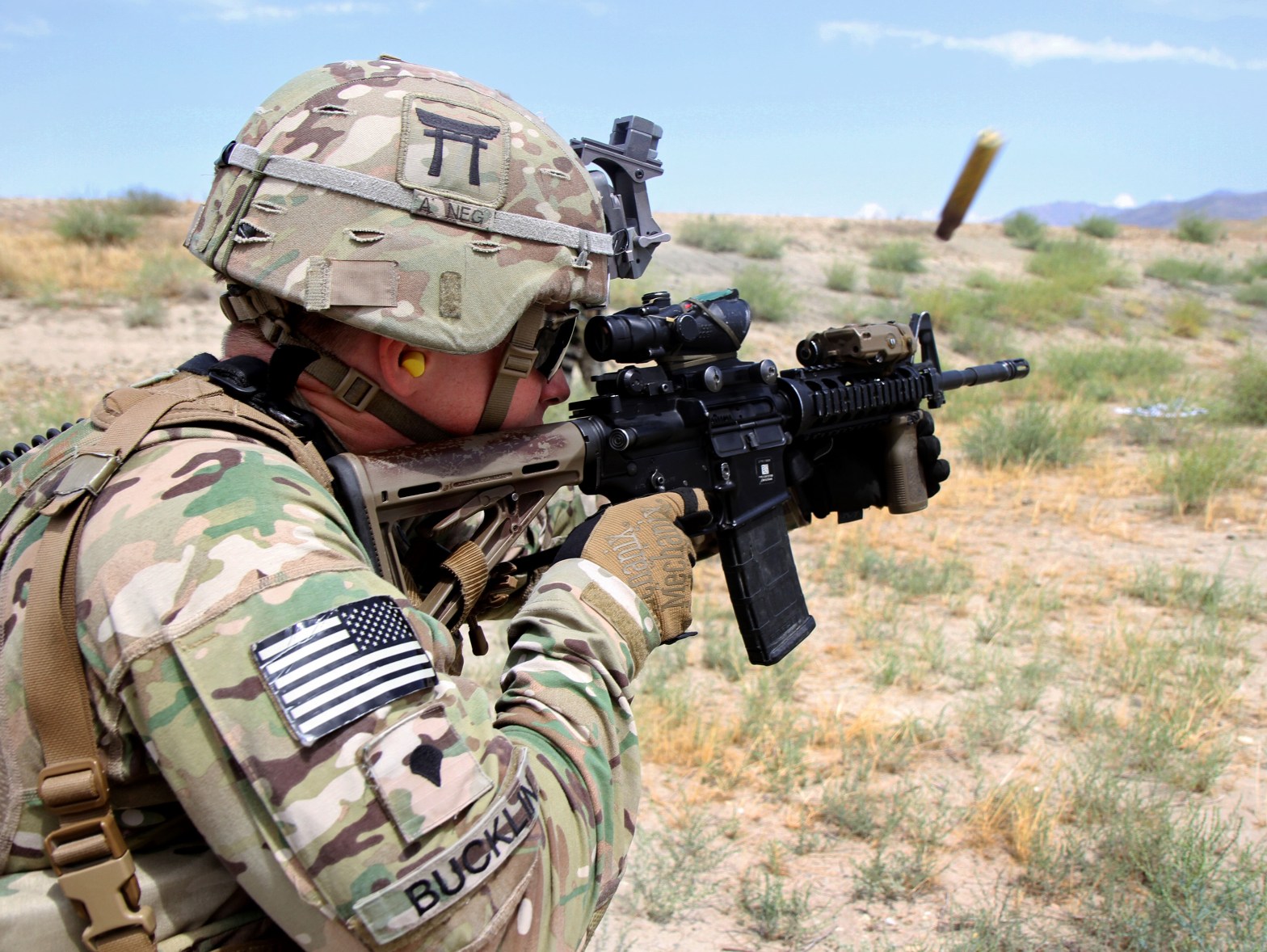
The fourth principle of leadership relates to a soldier’s weapon. The U.S. Army primarily uses the M4 Carbine, Caliber 5.56 mm, M4 rifle. Described as one of the defining firearms of the 21st Century, it is a gas operated, bolt action weapon with an effective firing range of 500 meters at individual targets. A soldier’s basic load consists of seven, 30 round magazines, and the rifle has a modular frame to add various handles, flashlights, night vision devices, and scopes to enhance its lethality.
On the front soldiers can attach the M9 Bayonet, a multi-purpose, seven-inch knife for close quarter combat. Everything about this rifle is designed to find and engage an enemy in close combat on the battlefield and achieve victory.
The Need for Offensive Operations
Leaders deliver results—period. The rifle of a soldier is a constant reminder that leaders must engage others, face problems head on, and gain ground to be successful. A leader’s job is to generate wins for the good of the organization which requires offensive operations. When leaders walk onto the field equipped with an offensive mindset, others know that they’ve come to win.
On July 2 of 1863 during the Battle of Gettysburg, Union Colonel Joshua Chamberlin, commander of the 20th Maine Regiment, stood on Little Round Top watching 650 Confederate soldiers advance onto his position. His unit of 360 men was at the far-left flank of the entire Union defensive position which had to be held at all costs.
Running low on ammunition and watching Alabama Confederates climb against their positions, Chamberlin gave the order to fix bayonets to their rifles and drive the Southerners back. In essence, he ordered his men to close with and destroy the enemy.
In a bold and daring charge down the hill, the Union decimated the Confederate advance and forced a retreat from the Alabama units which lost nearly half their men. Chamberlin’s decision to engage in hand-to-hand combat with rifle and bayonet saved the Union Army from potential disaster. He knew the only way to victory was by direct conflict against the enemy.
The Bayonet Charge
While it would be nice for leaders to handle every situation from afar, most times it requires attacking the problem head-on to get results. Leaders must get dirty at times. They can’t assume victory will naturally occur. They have to use their rifles, fix bayonets, and charge down the hill to deliver results on the ground. They can do this in several ways.
- Lay Out Clear Decisive Points. Every organization needs specific goals. A decisive point is a tangible objective that, when acted upon, contributes materially to success. The team needs to clearly understand what decisive points to invest time and effort on to accomplish their mission.
- Ruthlessly Focus on Victories. Winning matters. At the end of a football season, there is only one stat that fans care about – the number of wins. While leadership encompasses so many different social aspects, being on a winning team is paramount to positive culture.
- Celebrate the Wins, Consolidate Gains, and Take More Ground. Once an organization generates wins, they need to celebrate. Immediately following, it’s critical to take those realized gains and turn them into follow-on successes. There is always another hill to take.
On the opposite side of the spectrum, be careful to avoid these tripwires.
- Don’t: Ignore Problems. The temptation to avoid a problem you don’t want to deal with is great. It is much easier to ignore an issue than to fix bayonets and charge. Leaders have to confront problems as they arise, or they can grow into bigger problems.
- Don’t: Fight Your Battles Alone. One soldier’s rifle during a fight is good. Bringing their 800 buddies in an infantry battalion is much better. Organization success is a team sport. Leaders must ensure they are leading the charge, not conducting an individual charge up the hill.
- Don’t: Run Too Far ahead of the Organization. It’s easy to envision a desired future without providing the proper guidance, direction, and resources. Leaders must be out ahead of their team, but if they get too far, they lose the psychological connection needed for success.
Close with and Destroy the Enemy
You are equipped with the rifle of leadership. It’s important to have an offensive mindset to engage problems in your organization and generate wins for your team. Moreover, you’re designed to take ground—it’s what leaders do.
Next time you face an issue, grab your rifle and affix bayonets and get ready to close with and destroy your problem.
Subscribe at this link above to The Maximum Standard. This platform is a free, no-ad site designed to help others live up to their full potential as a leader. Thank you for committing to something greater than yourself. Your leadership matters.
We are also looking for authors. You will reap the benefits by having an idea, putting it down on paper, wrestling with it a little, and publishing it for others to see. I encourage you to take this bold journey with us. We have editors standing by to help you.
Boots: Put Boots on the Ground (1 of 5)
Regimentals: Place Service over Self (2 of 5)
Armor: Be Resilient to Life’s Attacks (3 of 5)
This website is a personal blog and all writings, podcasts, opinions, and posts are the authors’ own and do not represent the views of the United States Army nor any other organization. Podcast music credit in this audio file is to: “Alex Productions – Legends” is under a Creative Commons license (CC BY 3.0). / @alexproductionsnocopyright Music promoted by BreakingCopyright: • 🌆 Royalty Free Epic Cinematic Music -…
 The Maximum Standard