February 19, 2026
by Ralph “RJ” Johnson
“Major VC, stop asking, just execute. I trust you. You have my intent and guidance. Let me know if you need me to knock down an obstacle in your way, otherwise RUN!”
These were the words said to my Assistant Operations Officer three months prior to deploying 60 personnel, vehicles, and $25 million of equipment 1,600 miles to the West Coast for our military exercises RED FLAG and BAMBOO EAGLE. It was a highly visible event with many moving parts, and he was understandably cautious about getting it wrong. But he had already shown me his ability to plan, coordinate, prepare, and execute large exercises in the past; each success added trust to the bucket. That little affirmation helped facilitate his confidence and yield a successful deployment, execution, and redeployment of personnel and equipment across multiple locations, even garnering Air Force-level accolades.
In high-performing teams, there is a critical ingredient that is non-negotiable. Without it, initiative dies, risk aversion paralyzes decision making, subordinates avoid action, and leaders revert to firm control that stifles growth. Basically, the mission fractures. This ingredient is trust.
The Decisive Factor
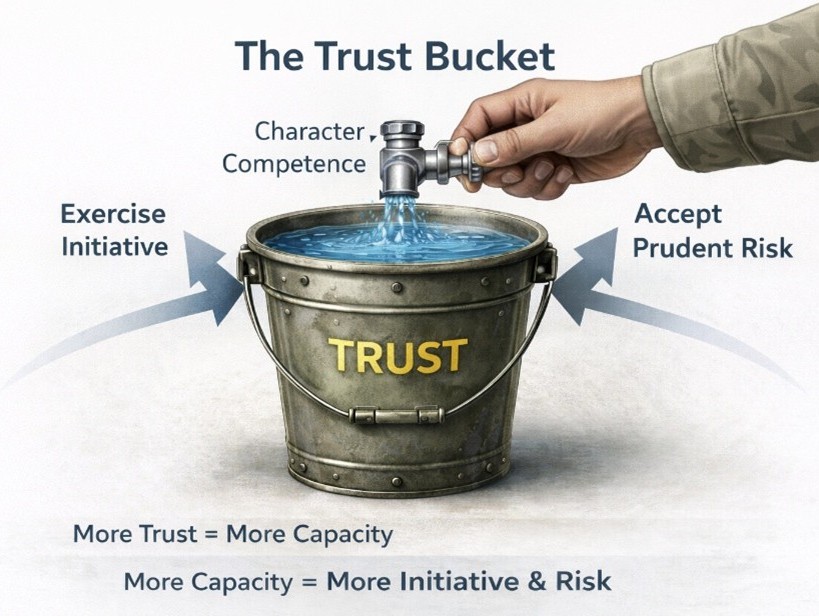
Trust is the invisible force that turns guidance and intent into action, strategy into execution, and teams into something greater than the sum of their parts. It determines the level of capacity an organization has to seize the initiative and take prudent risks to maintain a competitive advantage. In my Air Force Air War College studies on how to develop culture, I think of organizational trust as a bucket. A shallow bucket creates minimal initiative and risk-taking. When the bucket is full, speed, adaptability, and freedom of action are unlocked.
When a follower decides to exercise initiative and accept prudent risk, they place their personal and sometimes organizational reputation on the line. Here, they are operating in a space where their boss may or may not agree or approve. Basically, a person in this position must ask themselves: “Am I willing to take action that I know is important without fear my boss will punish me for doing so, even if it doesn’t work?”
The Confluence of Trust, Initiative, and Risk
Stephen Covey describes trust as equal parts competence and character. He believes character is rooted in integrity, values, and ethics while competence is rooted in judgment, skill, and reliability. Subordinates must believe their leaders have the requisite knowledge, judgment, and skills to lead them, and supervisors must believe their team is trained and proficient in their functions with the mindset of doing the right thing to make progress.
We all want to be surrounded by people of competence and character; we want to be those people too. These trusting relationships create initiative and risk acceptance on behalf of the boss to make things happen when they’re not around.
Initiative is empowered judgment and action in key moments to take advantage of an opportunity. It’s confidence in the level of mutual trust between two people to act when orders and policies do not fit the current situation. It also fosters responsiveness, allowing teams to navigate challenges and solve problems.
Risk acceptance is the judgment to move forward with a mission or task after careful consideration of potential loss to resources or objectives. It’s about understanding the risks clearly and making deliberate decisions. It is not recklessness; it is informed action.
Both initiative and risk acceptance require trust, because without it, the faucet closes.
Trust Unlocks Disciplined Initiative and Prudent Risk Taking
The world is rapidly evolving, both in warfare and business. Artificial intelligence, the race for quantum computing, evolving technologies, and more have made the military and business landscape extremely competitive.
So how do teams not just survive, but create advantage in this environment? Trust! It is the only way to increase speed, agility, and adaptability to capitalize on opportunities. No single leader can micromanage a fast fight or evolving business landscape. No leader can script every contingency. And no team can adapt when everyone is waiting for permission.
When trust fills the bucket, teammates have the confidence to shoulder their share of the task. Teams act with unity of effort and have a bias towards action. Initiative flows from the bottom up, not the top down. And the beauty is, things happen automatically!
Major VC understood that terrain and weather would complicate long-haul communications during our exercise. Rather than wait, he coordinated with a sister squadron in Hawaii to secure advanced communications equipment. He later back-briefed me on his actions and the associated $900 shipping cost. I was happy. Why? Because he solved a problem using three essential items: my trust, intent, and boundaries to operate within.
A key role as leaders is to maximize mutual trust, allowing our people to increase ownership and freedom of action. The more trust flowing into the bucket, the safer our people feel to make decisions and take action to accomplish the mission when we’re not around.
The Harsh Reality on Trust
Here is the uncomfortable truth: most organizations say they value trust but operate on fear.
Fear of failure. Fear of judgment. Fear of punishment.
Fear punches holes in the bucket, and our trust leaks out. This is catastrophic because trust is one of the hardest things to build. It is gained in droplets and lost in buckets. It requires leaders of high standards, competence, and character who must live out their values every day in public and private. It doesn’t mean everyone has to like our message or decisions all the time. But words and deeds must be consistent.
Ways to Fill the Trust Bucket
Trust doesn’t appear on its own. It is earned through deliberate actions. Some ways to do so are:
- Reassure our team constantly on how much we trust them.
- Develop people of strong character and high competence.
- Courageously hold those who fail to meet standards accountable.
- Don’t lie, cheat, or steal, nor tolerate those who do. I’m sure we have the first half covered. Relentlessly enforce the second half.
- Assess decisions, actions, policies, procedures, and statements to determine: “Does this build trust, or erode it?”
- Match our words and actions in everything we do. Complete alignment!
Leaders control the faucet. Each interaction we have with others either adds trust to the bucket or punctures a hole draining it. The severity of the action determines the size of the hole. And some holes take a lot of work to patch up.
If leaders want teams to act boldly, we must create an environment where exercising initiative and accepting prudent risk are expected, honest mistakes are discussed rather than punished, and subordinates are encouraged and expected to think, decide, and act.
Low-trusting teams never won a war, built a great company, or held a nation together. But those teams that trusted each other to lead with boldness and confidence, up and down the leadership chain, to execute the boss’s intent and make it happen, achieved greatness.
Leaders don’t get the initiative they want; they get the initiative that trust allows. Remember to keep our trust bucket filled!
Bio: Ralph Johnson is a native of Texas, husband, and father of two, serving as an Air Force Special Warfare Tactical Air Control Party officer. He’s currently stationed at Maxwell AFB, AL as a student at Air War College. When he is not spending time with family or working, he enjoys fitness and Brazilian Jiu-Jitsu.
Check out RJ’s first article in The Maximum Standard here: The Leader and the Blacksmith
The views expressed here are the author’s own and do not necessarily reflect those of the Department of the Air Force, Department of War, or the U.S. Government.
 The Maximum Standard
Another excellent and thoughtfully written article—thank you for sharing it!
The section that resonated most with me right now is “The Harsh Reality on Trust.” It powerfully captures just how challenging trust-building truly is, especially in leadership. This is something I am actively navigating as I continue to lead a relatively new team. Even after a year, I recognize there is still meaningful trust to be built. With some, the trust bucket feels full; with others, I am still repairing old holes created before my time.
My hope is that, over time, they continue to see that I lead with authenticity and integrity, and that I genuinely want to empower them to make decisions, grow, and develop—while remaining present to support them, catch them when they stumble, and help guide them forward. This article articulated those realities so well and felt incredibly timely and relevant. I truly appreciate the insight you shared and look forward to reading the next article you release.
LikeLike
Thanks for sharing some great insight on this article and your takeaways. From reading your response, it made me remember that building trust is a journey, not a destination. Like you said, I’ve done well at filling up my bucket and often poked holes in it myself when dealing with other people. I excel and I fail. It’s so important to just keep filling. Appreciate your thoughtful response, and agree the R.J. is a talented writer! Steve
LikeLike