April 2, 2026
by (Huy) Alex Le
“I’d rather be lucky than good.” People often say or think this when cutting things close. But in practice, it’s flawed reasoning because it’s not a choice of one or the other: lucky or good. Instead, luck happens when we create opportunities by taking action in the spaces around us.
Luck is about combining what we have with whatever’s available. In other words, “capabilities plus opportunities equal success.” Within the past few years, I have realized several ways in which we make our own luck. We do this by staying open to opportunities, strategically positioning ourselves, taking risks, and seizing moments. Finally, as we create our own luck, it’s our job to help others create theirs as well.
Genuine Luck Prevails
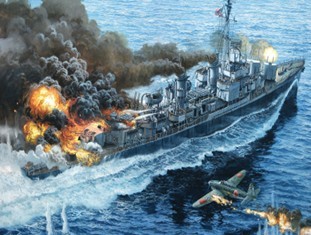
Luck isn’t something we’re born with. It’s the result of our efforts. “The Ship That Wouldn’t Die” is an extraordinary study in this.
On April 16, 1945, the USS Laffey of the Allen M. Sumner class faced the largest kamikaze attack ever leveled against a single ship. Under Navy Commander Frederick Becton, the Laffey directed all guns on her attackers. As damage and casualties mounted, her crew took measures to stay afloat, including partial flooding, evasive maneuvers, and working with friendly air patrols.
The Laffey took ten direct hits, and the crew kept fighting “… as long as there was a single gun left to fire.” Today, the Laffey floats as a testament to the luck of her crew. But we know it wasn’t just luck that kept them alive. The captain continuously made decisions to position the ship to have the best chance of survival. Blind luck didn’t keep them afloat. Purposeful choices, risky maneuvers, and capitalizing on environmental conditions were the differentiators. They followed the four ways to make their own luck.
1. Stay Open to Opportunities
Opportunities are out there waiting, but it’s up to us to find them. This happened to me as an Army National Guardsman when I volunteered for a military deployment.
In 2023, my unit was seeking soldiers to accompany its parent brigade in a rotation to train Ukrainian military units. I immediately volunteered, but the position somehow vanished. Simultaneously, however, the brigade was also preparing another battalion to deploy to the Horn of Africa. I volunteered again, staying open to any opportunity that came my way. If we’re not continuously seeking opportunities to thrive, they won’t show up for us.
The crew of the Laffey understood this well. Captain Becton saw opportunities to keep the ship afloat, whatever it took. He didn’t just wait for those actions. He made them happen.
When we’re proactive and open to alternative opportunities, we have a better chance of finding our luck. Without doing so, we remain in our metaphorical bubbles.
2. Put Yourself in the Right Place
The next step to luck is to strategically place ourselves in positions to maximize our advantage. Getting our foot in the door gets us closer to our goals.
In my deployment opportunity, the brigade was building its two task forces within an ever-shrinking time window. I understood that soldiers within the brigade had an easier time getting onto the deployment, and I positioned myself inside the unit to fill the open slots, subsequently being accepted to the deployment.
We need to constantly be seeking the place where luck happens. As the skipper, Becton took great responsibility in directing everything, including the ship, his crew, their guns, and himself to be in the right places at the right times. This was how he made his own luck.
We must always move to the point of opportunity before the opportunity moves away from us.
3. Take Calculated Risks
Creating luck is an active process. It often takes professional risks to make it happen.
The greatest risk I took on this deployment was balancing my obligations as an Army officer, a high school teacher, and a graduate student. In the two weeks following my Captain’s Career Course and right before the deployment, I had to pull all-nighters to plan the final month for my high school students and request late assignment exceptions for my graduate course. It was a lot, and a risk, but after settling those affairs, I flew down to Fort Barfoot and integrated with the Africa-bound unit.
Upon arrival, I became the unit’s primary safety officer and knowledge manager due to a manpower oversight. I had no prior experience in either role. But like the unit motto says, “No Step Backward.” If I didn’t take those risks, then I wouldn’t have opened new doors to opportunities.
Becton drove the Laffey like he stole it, circling at full speed to stave off the kamikaze fighters. Without this risk, the ship may have been lost. Luck requires more than living a status-quo life. It often demands calculated risks.
4. Recognize and Seize the Moment
Finally, we create luck by understanding where we are in life and capitalizing on those opportunities.
No one asked me to be a teacher, a soldier, a graduate student, or a tutor. I made those leaps of faith based on opportunities before me. Luck happens when we seize the moment. Prior to flying out to Africa, I had our safety and knowledge management programs established and working for the task force. From the moment I volunteered and was accepted to the unit, I made those moves toward luck.
The same was true with Commander Becton. He fully understood the threats of a kamikaze attack. But instead of hoping his crew would be successful, he took action and seized the moment through his leadership to fend off the attack. His decisions saved the ship as he seized the moment.
These examples of simple volunteerism and complicated warfighting show how luck never comes to us; it waits for us to step forward to claim it.
Create Luck for Others
Leaders set conditions not only for their own luck but for the luck of those around them. They do this by making opportunities, putting themselves in the right positions, taking risks, and seizing the moment.
From my deployment experience, I knew I wanted to prepare our replacements as best I could. The digital workspace I created and refined became an enduring blueprint. I codified my experiences into interactive manuals. Once our replacements arrived in the country, I meticulously trained them so that they could be just as successful. Hard work from both sides guaranteed a successful handoff.
It’s not better to be lucky or good; it’s better to be both. Captain Becton proved this as he made several challenging decisions to ensure his crew was lucky.
Ultimately, the story of the USS Laffey isn’t about a ship that survived by chance. It’s about a captain and crew that stepped forward to claim their own luck. The odds of us facing an air attack aboard a ship are low. Still, we will navigate the bureaucracy of life. Always work hard and position yourself well to make your own luck. Then help those around you make theirs.
(Huy) Alex Le is a 2019 alumnus of Drexel University and a Captain within the Pennsylvania Army National Guard. With almost ten years of service to date, he looks to rebrand himself as a logistics officer. After a successful deployment to the Horn of Africa under Task Force Associator from 2024 to 2025, he enrolled in a doctorate of education program with one course completed from Gwynedd Mercy University. He also started up a private tutoring business (https://tutorquickle.my.canva.site). Through these steps in his return to education, he seeks to not only continue bettering himself but also cultivate thinkers and potential leaders.
The views expressed here are the author’s own and do not necessarily reflect those of the Department of the Army, Department of War, or the U.S. Government.
Other articles by Alex Le: So What: The Question We All Need to Ask
 The Maximum Standard