
January 14, 2025
by Stephen T. Messenger
Wayne Johnson was new to the company, and it was his first time sitting in a meeting with the senior leadership team. The conversation was fast-paced, exciting, and interesting. Wayne really thought he would like this new job.
Halfway through the meeting, Janice, who ran the human resources department, asked Wayne what he thought of the onboarding process. Wow, thought Wayne, I’ve only been here a week and I’m already being asked about my opinions. An extroverted person to begin with, he was thrilled to share.
Wayne opened up about his experiences in onboarding: the good, the bad, and the ugly. He referenced his former company, how he was treated upon arrival, and the strengths and opportunities of the human resources department. After 15 minutes, Wayne provided what he considered an excellent summary of what to sustain and how to improve. The meeting quickly wrapped up afterwards, and he walked back to his desk.
What a day!, Wayne reflected. I’m already making a huge impact in my new position.
The Feedback
Wayne sheepishly knocked on Bryan’s open door, “Hey, you got a minute?” He met Bryan Green during onboarding, and Bryan offered to help if he needed anything. Bryan just seemed like a sincere and caring person.
They were both in the meeting this morning, and Wayne recounted how Janice pulled him aside about an hour ago. She told him, in a very nice and professional way, that his 15-minute speech to all the senior executives was long and rambling. Since the meeting was on a tight schedule, Janice hoped that Wayne would quickly share one or two points, and they could move on.
Instead, in her words, Wayne’s diatribe full of tangents and stories that didn’t help the leadership team came off as preachy and overbearing. In the future, he should look to follow the three B’s of speaking: Be brief, Be brilliant, and Be gone.
“I’ve never heard before that I’ve had a problem speaking in public. What do you think, Bryan?”
Bryan gave a genuine smile and leaned back in his chair, “Sounds like you’re suffering from what we all suffer with. Blind spots.” Then he asked, “Have you heard about the Johari Window?” and went to the whiteboard and drew a simple picture. “Let me explain.”
The Johari Window
The Johari Window is used by teams to expand levels of self-awareness among each other. For new people in a company but also for those that have been there a while, there are many unknowns on both sides about how people think and act. The Johari Window helps everyone in a group improve this understanding.
It was created by American psychologists Joseph Luft and Harry Ingham in 1955 and branded by combining their two first names (Joe-Harry). It’s core concept is that there’s a lot of information about yourself, but not everybody knows it, including you.
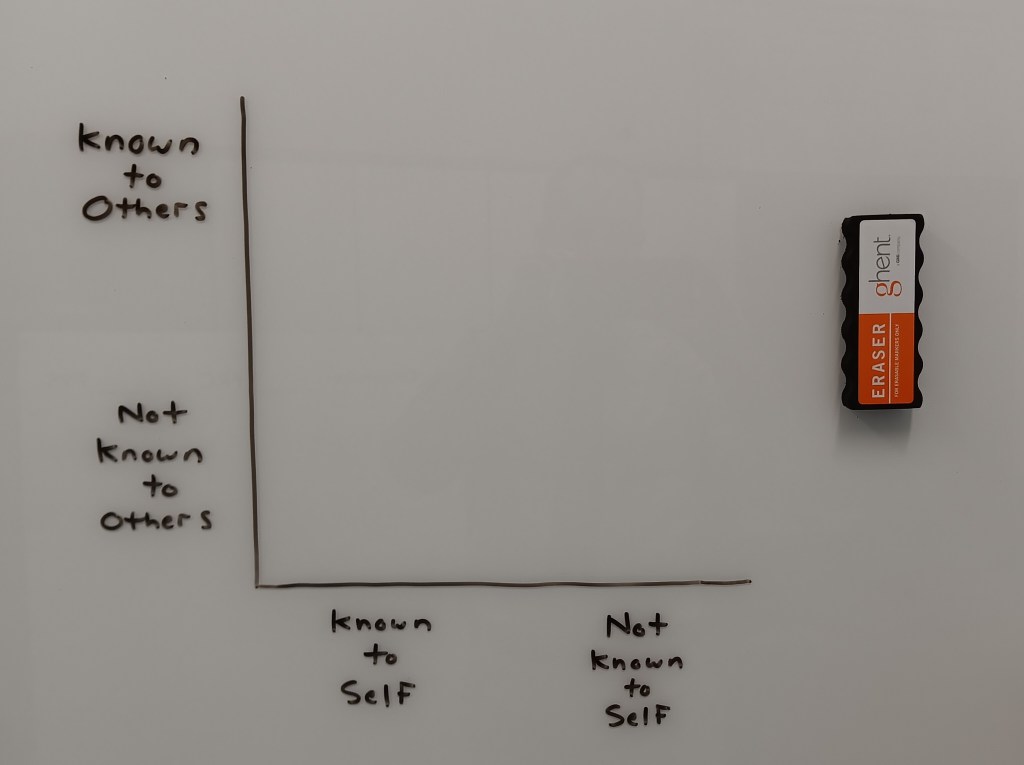
The Y-axis represents things that others know or don’t know about you. On the top are things we all know about you. For example, after you talked today, everyone now knows who you are, where you came from, and your public speaking style in meetings (he smiled). On the bottom are things we don’t know about you like how you best like to communicate, your conflict management style, and your favorite birthday cake.
The X-axis represents things that you know about yourself. The good news is you know a lot! The bad news is, there are some things that you don’t know like how you’re perceived in public (he smiled again) and what others think of your communication style. This entire window divides into four quadrants:
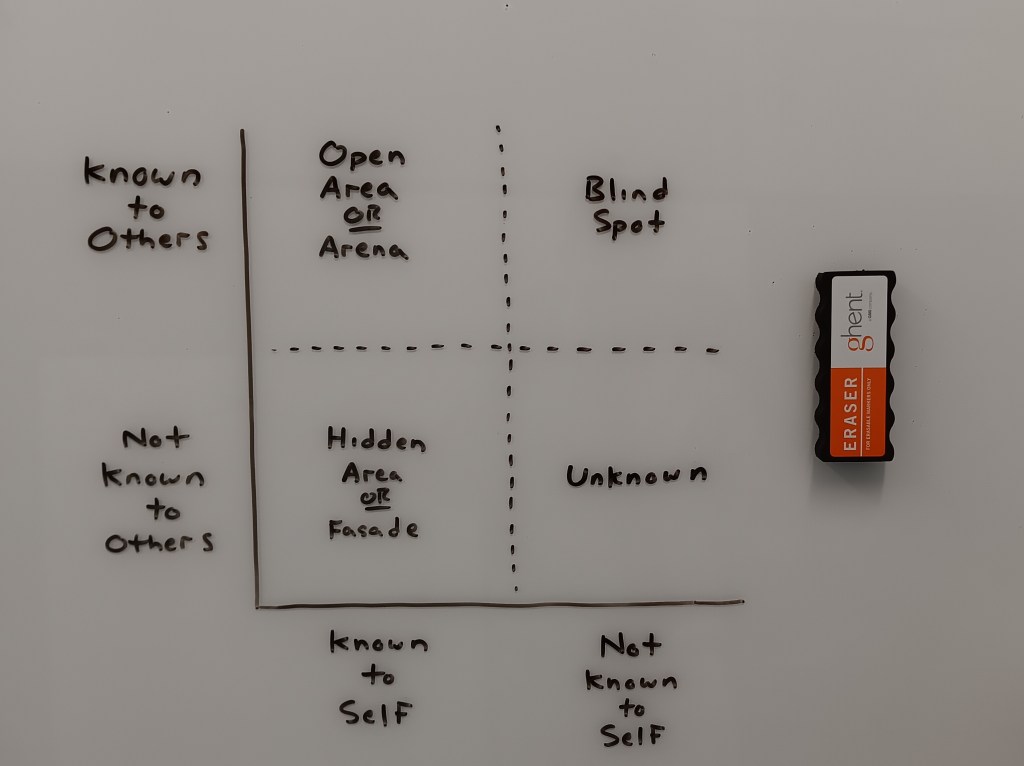
1. Open Area or Arena. In the top left quadrant is what we all know to be true about you. It’s your stated attitudes, emotions, strengths, and views that we’ve heard and observed. This is where we’ve shared communication and feedback in the past and now have a common understanding. Every time we have a conversation, this area becomes larger. I learn more about you, and you learn more about yourself.
2. Hidden Area, Facade, or Mask. In the bottom left quadrant is information that you know but haven’t shared with us. It’s the feelings, emotions, scar tissue from the past, fears, hopes, and dreams that you’re keeping to yourself. This is natural because we all have private thoughts that we don’t always want to share.
3. Blind Area or the Blind Spot. The top right quadrant represents the stuff we know about you, but you don’t know about yourself. Just like the feedback you received, a lot of other people were thinking it, myself included to be honest. But you aren’t aware of it. Every time you get feedback like today, it’s a gift to help reduce the size of this window.
4. Unknown Area or Unconscious. This is the trickiest one because we don’t know it about you, and you don’t know it about yourself. The bottom right represents hidden and suppressed feelings, unknown talents, or information about you that you haven’t even processed yet. They may have come from past experiences as a child or a skill that you haven’t discovered like writing or a foreign language.
When you put all these together in the window, you can start to see how others look at you differently than you look at yourself. Perhaps you think your message came off clear, but everyone in the room thought you weren’t getting to the point quick enough in an already time crunched environment.
By the way, the four windows are never the same size. For new people to a company, like you, the windows may look out of proportion like this:
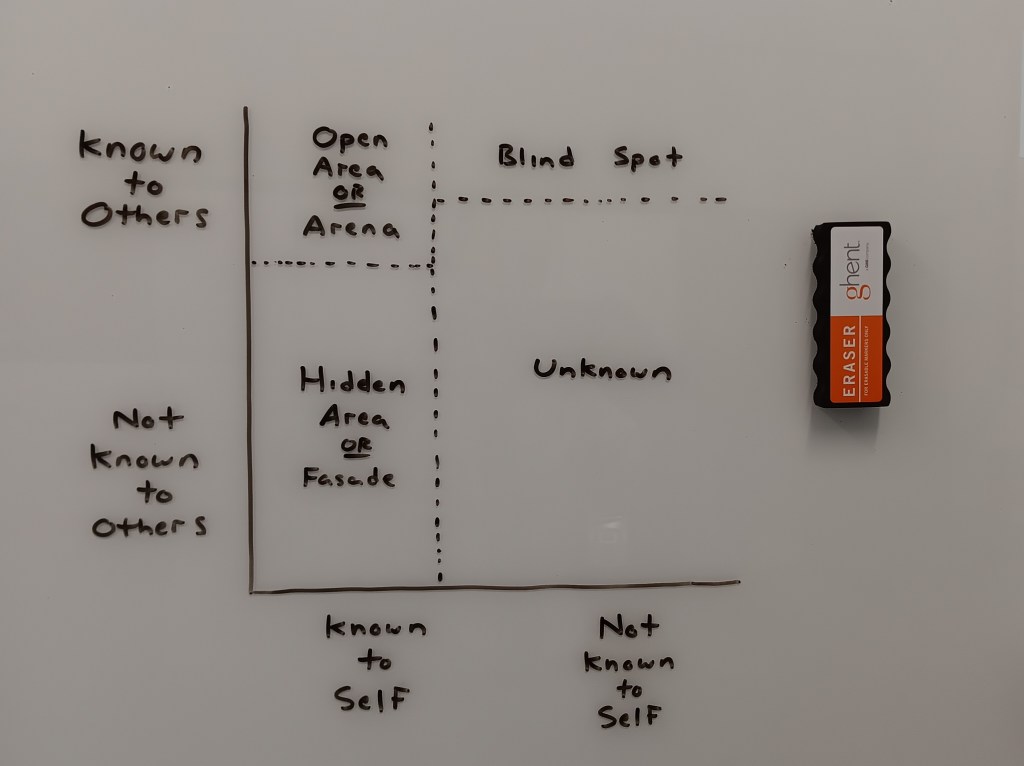
We know very little about you since you just arrived. Your open area is small because we’re just getting to know you. Your hidden area is pretty big because you know a lot about yourself, but we don’t know a lot about you. And we all have blind spots. Plus, the unknown is big because you’re new to a company and you don’t know what you don’t know. As we start to interact with you, we’re all going to make judgments and opinions, and you’re going to make them about us. They may or may not be in line with what you already know.
The good news is, we can push open the arena to our own Johari Window in two ways.
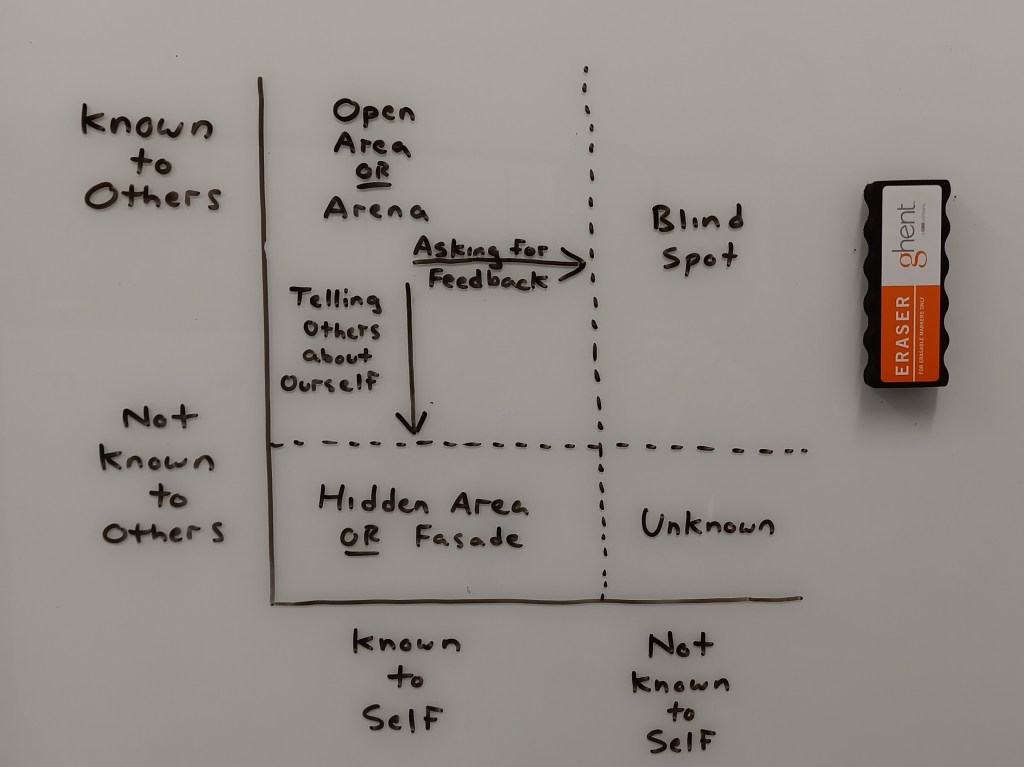
First, we can tell other people about us. This can be done through meet and greets, small group conversations, having lunch with coworkers, water cooler talk, or countless ways just to share things. Having coaching sessions with people at work is a great way to expand the window down because it’s all about us talking and the other person asking questions.
The second way is to ask for feedback. When we ask others to tell us about ourselves, it pushes the windows to the right as we gain more information we didn’t know before. Feedback is a gift. Sometimes it comes unsolicited and sometimes when we ask for it. Either way, the more we know about ourselves, the more we can use that to be a great team player.
As an afterthought, there are thousands of permutations of this window in an organization. I have one with you, you have one with me, I have one with the senior leadership team, and you have one with the three people in your office.
The best organizations are good at expanding the open area so that common knowledge is shared professionally across groups, and everyone can use that information to best communicate. We should all be sharing information about ourselves and giving and asking for feedback every chance we get. This allows teams to best work together.
Wayne nodded thoughtfully. “I appreciate the chart, Brian. But you didn’t answer my question. Did I talk too much this morning?”
Without hesitation Brian responded with a grin, “Absolutely. And think how much your Johari Window open area grew today.”
Leaders read, think, discuss, and write about leadership. Your first step should be to sign up for The Maximum Standard’s weekly email where you’ll get a leadership vignette delivered for free every Tuesday morning! This could also be your year to get published in the Maximum Standard—we’re always looking for authors. Lead well
 The Maximum Standard