March 20, 2025
by Alexander Limber
“I came through and I shall return”
-Gen. Douglas MacArthur
Unfortunately, we all fall victim to broken trust at one point in our lives. For me, not only did I lose trust in someone, but I also lost a friend because of it. I used to be very close with a person who relied on me for help, and as a good friend I was always there for them; however, when the tables were turned, they were never there for me. This person would constantly make false promises and, over time, I slowly lost trust in them until their credibility and image were shattered in my mind.
This is both a warning and a lesson as we lead because when we’re in charge, all eyes and ears are constantly assessing our credibility. Our words and subsequent actions determine our trustworthiness and shape our legacy. Leadership is built upon the foundation of trust between us and our people. It can sometimes be challenging to live out every commitment we make; however, it’s our duty to make good on our promises.
General Douglas MacArthur is a prime example of maintaining credibility as he was a profound leader and a dedicated commander who was committed to keeping his word even in the face of adversity.
MacArthur: A Hard Promise
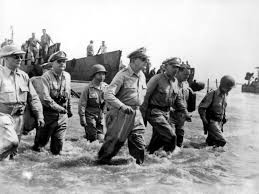
Following the attack on Pearl Harbor, Imperial Japan launched an invasion of the Philippines on December 8th, 1941. Here, MacArthur and his combined U.S. and Filipino forces would courageously defend against the assault until May 1942 when President Franklin D. Roosevelt ordered MacArthur to give up the island. MacArthur was forced to make a hard decision to leave his beloved Filipino people behind and inevitably retrograde to Australia to rethink his Pacific theater efforts. However, before he left he made a vow to the people of the Philippines declaring “I shall return,” marking his everlasting commitment to those he fought alongside. MacArthur’s pledge shaped the course of history by promising the people of the Philippines that he wouldn’t abandon them. He had become a beacon of hope for the Filipino people as they suffered under control of Imperial Japan.
Still loyal to the United States and inspired by MacArthur’s promise to liberate them, resistance groups formed in opposition to the occupation. Many of the fighters were trained by American forces prior to the start of WWII and personally by MacArthur himself beginning in 1935, which helped support their trust and faith in the general’s return. The resistance fighters would continue to resist the Japanese for two and a half years before MacArthur would return to the Philippines, leading Allied forces to liberate the Island. He would make good on his promise and demonstrate his commitment as a leader by staying true to his word. Even to this day the Filipino people commemorate Douglas MacArthur for his actions.
Our Credibility Defines Our Trust
The importance of keeping our word cannot be overstated because it shapes our credibility as leaders. MacArthur demonstrated the importance of this. His promise to return was credible in the minds of the Filipino people. They believed wholeheartedly that MacArthur would rescue them, so they continued to fight. As leaders, we need to recognize that our words followed by our actions impact our organizations for better or worse. Our people look to us for guidance and direction. However, by making false promises we diminish our credibility and burn the bridge of trust. That’s what happened with me and my friend. I could no longer trust this person and had to sever the relationship. This is why we always need to think about how our words and actions affect those around us. Our credibility shows others that we can be relied on even during times of adversity.
The U.S. Army believes that mutual trust is a crucial part of leadership and essential for a cohesive organization. According to Army Doctrine Publication 6-22, Army Leadership and The Profession: “Trust enables the ability of leaders to influence subordinates and effective command and control. Trust encompasses reliance upon others, confidence in their abilities, and consistency in behavior.” By having trust across all levels within the Army, it enables mission accomplishment. Our level of effectiveness is directly correlated to our level of trust in our leadership and each other.
Words Followed by Action Establish Trust
From an individual perspective, we lose trust in those who give us false hope by breaking their word. Leaders need to be mindful of what they say and what they promise to their people. If we forget to follow through or make an unrealistic promise, it could result in adverse effects such as lack of trust from others. If this becomes a pattern, they may even predict we will let them down in the future. In contrast, leaders sticking to their words and following through on commitments leads to the development of trust.
For example, MacArthur had cultivated an environment of trust when he was the military advisor for the Philippines prior to WWII, constantly demonstrating through training, speeches, and events his love of the island. Based on his performance and care of their people, Filipino President Manuel Quezon bestowed the rank of Field Marshal to MacArthur. Through his initiatives, MacArthur fostered and developed trust with the people of the Philippines to the extent where when he promised to return, they did not doubt him for a second.
As leaders we are able to establish trust within our organizations by being dependable. When we say we’re going to finish a project, we finish it quick and report our progress. When we say we’ll send a text or email, we don’t wait but instead knock out that task. When we say we’re going to be there, we show up on time, every time without fail. And when we say we will return, we will also come back. We have to continuously and predictably demonstrate that our words and deeds are the same.
Leaders Are Credible
The fact is that a leader’s credibility is reinforced by their words and actions. We must be mindful of what we say and do, as a mismatch can impact the way that we’re seen by our people. This loss of credibility and trust affects the cohesiveness and effectiveness of our organizations. The good news is that like Douglas MacArthur, when we focus on unequivocally keeping our word, our credibility is established just like the general did to the Philippines.
Alexander Limber is a student at The University of Akron, majoring in Emergency Management and Homeland Security. He is a Cadet in the Akron Army ROTC program and is looking to branch Infantry or Armor. His hobbies include weightlifting, reading, and spending time with friends and family.
Leaders read, think, discuss, and write about leadership. Your first step should be to sign up for The Maximum Standard’s weekly email where you’ll get a leadership vignette delivered for free every Tuesday morning! This could also be your year to get published in the Maximum Standard—we’re always looking for authors. We coach first time authors (and anyone) through the writing process if you need a little help. It’s worth taking the first step and showing interest.
This website is a personal blog and all writings, podcasts, opinions, and posts are the authors’ own and do not represent the views of the United States Army nor any other organization.
 The Maximum Standard