July 8, 2025
by Stephen T. Messenger
We’ve all gotten vague directions from a boss. With the good ones, it’s easy. We ask, clarify, and move out. But with others, we hesitate. Let’s be honest. Sometimes, we’re scared to ask.
Leaders need to cultivate an environment of approachability with their people. Those who are personable, open to questions, and team players create an environment where others feel free to question their boss’s intent without fear of repercussion. Those who aren’t can cripple an organization.
I once delivered news about a senior leader’s surprise visit to a person of significance and how we would support them. They responded with gruff, direct guidance that was contrary to much of what I knew about the visit. They said it with such confidence, and when I asked a follow-up question, they were dismissive and curt, immediately killing the conversation.
The input sent me down a completely different path, wasting time and energy trying to verify the false information they told me. But because of their confidence in saying it, I checked, double-checked, and triple-checked before I went back to tell them we were sticking to the original plan. What a waste of time!
Bosses who can’t be approached to clarify their intent can create dangerous environments. This next story about the FBI is a perfect metaphor for what happens when fear replaces clarity in an organization.
Watching the Borders
When J. Edgar Hoover was the Director of the FBI, he ruled with an iron fist. His subordinates rarely questioned even his most suspect orders, and he saw the Bureau as an extension of himself. Often, he would ask employees to run his personal errands.
At one point, he ordered that all memorandums have specific width margins. He wanted to write his comments on the side in response to the authors.
Once, handed a memo for review, he scribbled on the side, “Watch the borders.” His staff, not understanding what this meant, furiously polled the departments asking if there was something happening on the Mexican or Canadian borders that they should know about. In a popularized version of this story, and likely apocryphal, his staff took this as a directive to mobilize the U.S. Army to the Mexican border and began preparations for troop movement.
It turns out, Hoover wasn’t looking for border protection. He was upset that the memo margin spacing was violating his order, yet his people were afraid to ask. This cautionary tale demonstrates the danger in an unapproachable boss and a staff’s reluctance to seek clarification from confusing directions.
The Counterproductive Leader Deters Questions
People can be unapproachable for a number of reasons. The Army defines many of these reasons in its Army Leadership and the Profession. There are five counterproductive leadership behaviors below looked at with a lens on preventing subordinates from approaching their boss.
- Abusive behaviors. When leaders are mean, cruel, and degrading to others, they deter people from approaching them. They use words to belittle people, look down upon them, or mock them for asking what they consider stupid questions. Ironically, it is often their fault for not issuing clear guidance.
- Self-serving behaviors. This is seen when leaders put their own needs above the collective mission. They use arrogance and directive leadership to get things done right and fast, without care for others. They want to look good and feel threatened if questioned.
- Erratic behaviors. We all need predictability in bosses. We should know how they will react to good news and bad news while being able to reliably guess their emotional response. When leaders lose tempers, shut down, or are insecure, it lessens our desire to want to approach them.
- Leadership incompetence. When the boss demonstrates a history of poor decision-making skills, it’s often dangerous to ask for clarification because we don’t want to know what they’ll direct next. Some know they have shortfalls and some don’t, but either scenario deters approachability.
- Corrupt behaviors. These actions are in violation of standards and regulations where leaders are out there doing their own thing. They make it difficult to approach them when their actions are illegal, unethical, or immoral, and it’s less risk to determine their guidance without them.
When leaders exhibit these behaviors, it makes us wary of asking follow-up questions. We perceive the least likely response as receiving enhanced understanding of their intent, but the most likely response will be getting our head chewed off. This causes us to think twice before asking.
From this warning, we must prevent ourselves from being a boss that deters people asking for clarification.
The Keys to Approachability
The three simple things we can do to encourage other people to approach us are to be personable, open to questions and feedback, and team-focused.
Personable. First and foremost, we need to like the people around us. Simply by engaging others, asking about their day, knowing their families, and striking up conversations, we develop relationships.
Leader-member Exchange Theory is all about this. It’s where we don’t treat everyone equally, but form multiple, unique relationships with each person to improve how we interact with others. Getting to know our people is the cornerstone to being approachable.
Open to Questions and Feedback. Second and as discussed last week, small questions lead to big opportunities to grow trust. When someone asks for clarification, it’s because they want to understand how they can help more.
No matter how big and complex, or small and simple the question, answer it quickly, completely, and with a smile. And when someone wants to give feedback, always accept it and reflect on it, following up if needed.
Team Player. Finally, everyone around us knows if we’re a team player or not. They know by the things we say, what we do, and where we focus our time. If we exude that we’re here for others and the mission, and not ourselves, people will follow us anywhere.
There are many ways to be a team player, but my humble recommendation is to lift others up as much as possible. Recognize their successes. Applaud their work. Thank them continuously. Team players focus on other people and the mission, and not themselves.
Are People Knocking at Our Door?
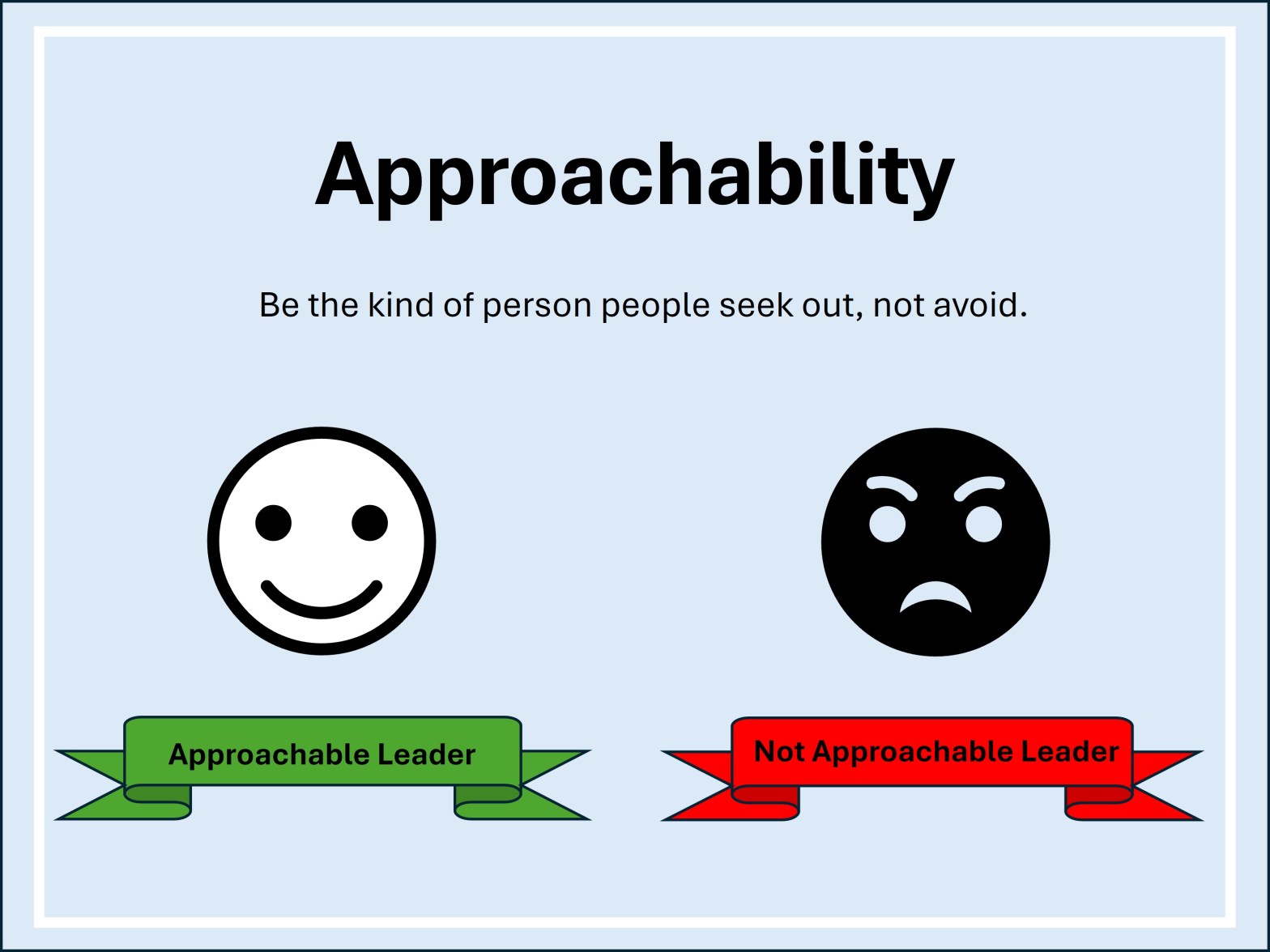
Here’s the litmus test of being approachable: people line up at our door, not out of fear but out of trust. We need to be the kind of leader people seek out, not avoid.
Don’t get caught in the counterproductive leadership trap. Instead, encourage people to come and find help through an approachable leader who is personable, willing to accept feedback and questions, and is a team player.
Click here to sign up for The Maximum Standard’s weekly email where you’ll get a leadership vignette delivered for free every Tuesday morning!
We’re always looking for authors. We coach first time authors (and anyone) through the writing process if you need a little help. It’s worth taking the first step and showing interest.
This website is a personal blog and all writings, podcasts, opinions, and posts are the authors’ own and do not represent the views of the United States Army nor any other organization. Podcast music credit in this audio file is to: “Alex Productions – Legends” is under a Creative Commons license (CC BY 3.0). / @alexproductionsnocopyright
 The Maximum Standard