September 23, 2025
by Stephen T. Messenger
There truly is only one finite resource we have and that’s time. There are ways to gain more money, knowledge, relationships, information, and more, but we can’t gain or lose time. It simply marches on.
That’s why we need to harness the power of the clock to our advantage. I see so many people struggle with time management. They say they don’t have enough time, as they spend hours literally wasting it on non-productive activity or items that aren’t the priority.
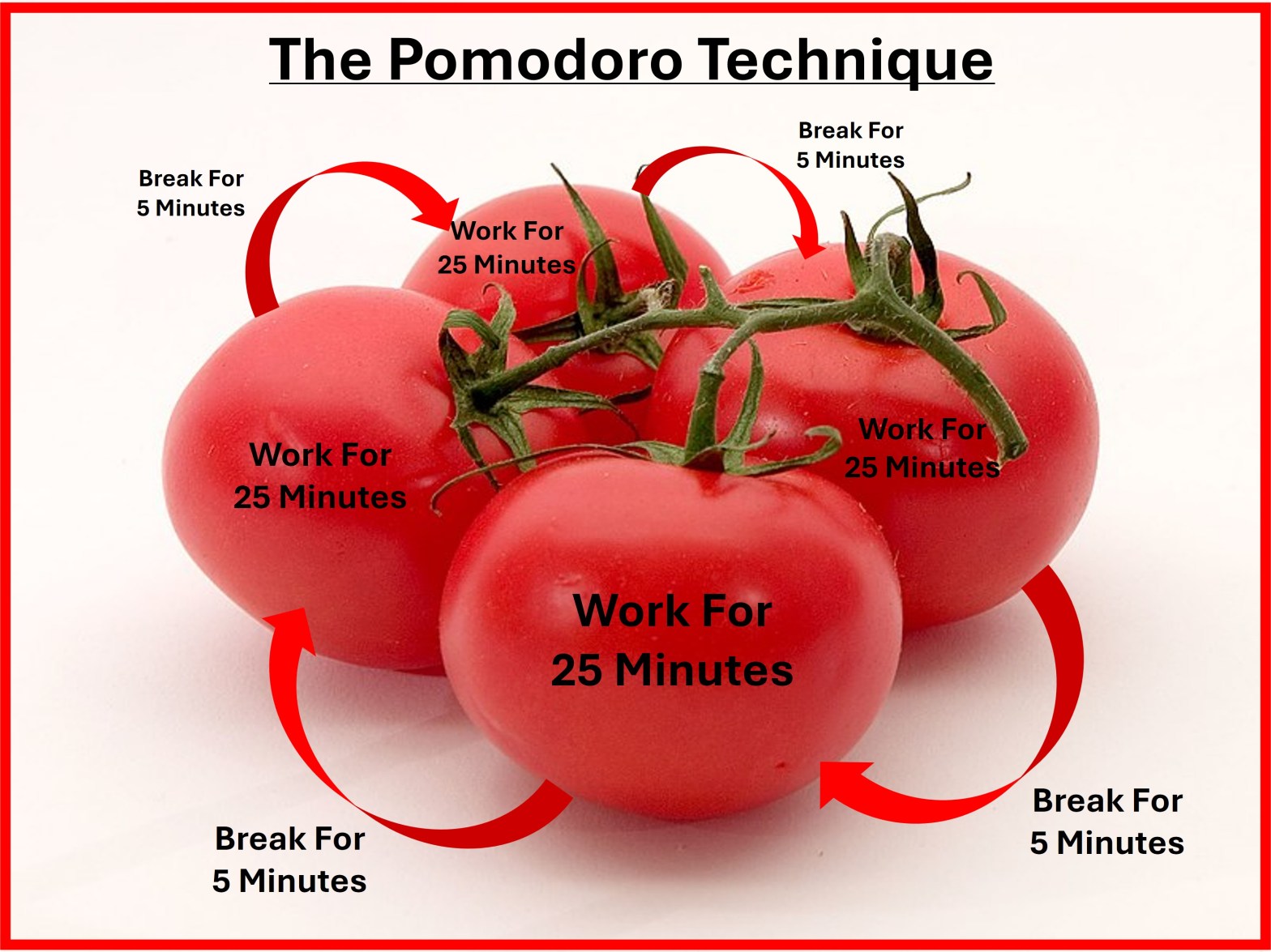
Instead of frittering away our time, we need to master it. The Pomodoro Technique is one of many ways to supercharge our time management skills, and it’s one I use a lot. This method breaks work into 25-minute intervals with short breaks in between. The goal is to focus energy into that time and take a short break to recharge immediately after, allowing our minds to prepare for the next segment. The result is intense, concentrated effort that gets things done.
There Are Only So Many Hours in a Day
I’m currently grading essays for a college class. Depending on the length and quality, it takes time to provide accurate and helpful feedback to students. When I ask my peers grading papers how long it takes them, their answers are all over the map from 30 minutes to two hours.
By that math, it could take up to 40 hours to grade 20 essays, leaving zero hours for anything else in a normal workweek. Of course, we all have tens of hours of other work, so that simply can’t happen.
Therefore, I use the Pomodoro Technique to allocate one hour to grade a paper. I eliminate all distractions—no other computer windows are open (ahem, email), the door is shut, the phones are on silent. From the time I open an essay to the time the final feedback is in place, I have to be done in 60 minutes.
I take a short break and move on to the next one. Using this method, I provide the same amount of feedback to each student, know exactly how long it will take to grade the number of essays I have, and hyper-focus my effort without distraction. The result is standardized feedback for students and quality time management to do everything else I have to do.
The Pomodoro Technique
This time management theory was invented by Francesco Cirillo in the 1980s. The name “Pomodoro” is Italian for tomato, as Cirillo used a tomato-shaped kitchen timer when he was a university student. His theory was to maximize productivity by intensely focusing on a task for 25 straight minutes, then come up for air for a five-minute break.
These intervals called “Pomodoros” work to intensely focus our attention on the task at hand, but while still providing enough mental breaks to reset our brain and quickly get back in the game. This prevents exhaustion, minimizes stress, and mitigates burnout.
Using Our Tomatoes
There is nothing fancy about this method. First, we list all our tasks we need to tackle in a day and divide them into interval chunks. Next, we set the timer for one Pomodoro, or 25 minutes, and have our first task-chunk prepped and laid out in front of us.
Next, and what I believe is the most important part, we eliminate all distractions that could interrupt our work during this time. We find an isolated spot, turn off email, phone, notifications, and social media, shut the door with a sign on it that we’re working and not to be bothered, and have some water handy.
Now we start the timer and relentlessly focus on that task and nothing else. After the 25-minute tomato goes off, we take a five-minute break to relax, reset, and clear our minds. We then repeat the process over four Pomodoros and then take a longer break of 30 minutes.
Three Tomato Rules to Maximize Productivity
This technique has three rules we must follow if we’re going to make the most of our time.
1. Take big projects and break them down. Estimate how many Pomodoros we need for the total project and break it down into 25-minute blocks of actionable steps. We plan out our sections and then tackle them in sequence.
2. Group small tasks together. Those tasks that take less than 25 minutes should be combined with other less time-consuming items. For example, find five things that take about five minutes each and knock them all out in one Pomodoro.
3. Stay on task. Once the timer starts, it cannot stop nor can we get sidetracked. This block of time must be dedicated to our task at hand and nothing else – no email, phone, chats, nor drop-ins. Any stray voltage ideas should be captured and returned to later. Focus. Focus. Focus.
Now, there will be times when we get distracted by something unavoidable. No problem. Take a five-minute break and start again. Each interruption should be a learning point on how to prevent the same stoppage in the future.
On the flip side, if we finish our task early, find something else to be productive. Start the next task, overlearn, or take time to reflect.
The Benefits of Tomato Time Management
Increased Productivity. Short, focused energy with non-negotiable deadlines makes things happen. Without distractions, we maximize concentration and hence results. This method forces me to crank through papers and meet self-imposed deadlines.
Reduced Procrastination. When we clearly understand what tasks need to be accomplished and when, it forces us to get to work. Moreover, the schedule creates a sense of urgency. When I know I have a certain number of assignments to grade and only so much time, I feel forced to get to it.
Improved Focus. When we take routine breaks, it prevents our mind from getting tired and allows us to build mental endurance. We need this to stay productive all day long. When I’m on this system, I can routinely knock out one essay an hour, every hour.
It’s Flexible. We can make our intervals as long or short as we want. I use 50-minute blocks and 10-minute breaks. Consider making them longer or shorter than 25 minutes as it fits your personality and task.
Tomato It Up
The Pomodoro Technique helps us stay productive and efficient in managing our day. It’s a simple way of ensuring that we maximize our time through a mix of hyper-productivity and recharge breaks. This can be used for large projects, studying for a test, or routine tasks. If you’re looking to outwork everyone around you, this is a way to do it.
Click here to sign up for The Maximum Standard’s weekly email where you’ll get a leadership vignette delivered for free every Tuesday morning!
We’re always looking for authors. We coach first time authors (and anyone) through the writing process if you need a little help. It’s worth taking the first step and showing interest.
Subscribe above to join The Maximum Standard community. We are looking for others to lead along with us, write about leadership, and improve organizations. Clicking above will place you on our weekly, free email distribution list – no ads, no fluff. Just leaders connecting with leaders. Join us!
 The Maximum Standard
One thought on “The Pomodoro Technique: Managing Time Like a Pro”