January 20, 2026
by Stephen T. Messenger
“Accountability separates the wishers in life from the action-takers that care enough about their future to account for their daily actions.” – John Di Lemme
We’ve all been there. A project at work goes wrong, and we’re sitting in the conference room trying to understand what happened. One person acknowledges the failure but has no way to implement solutions. Another didn’t even know there was a problem. A third chimes in with ways to fix it.
Across the group, we’ll have a range of people who feel responsible and accountable to those who couldn’t care less about the project failing.
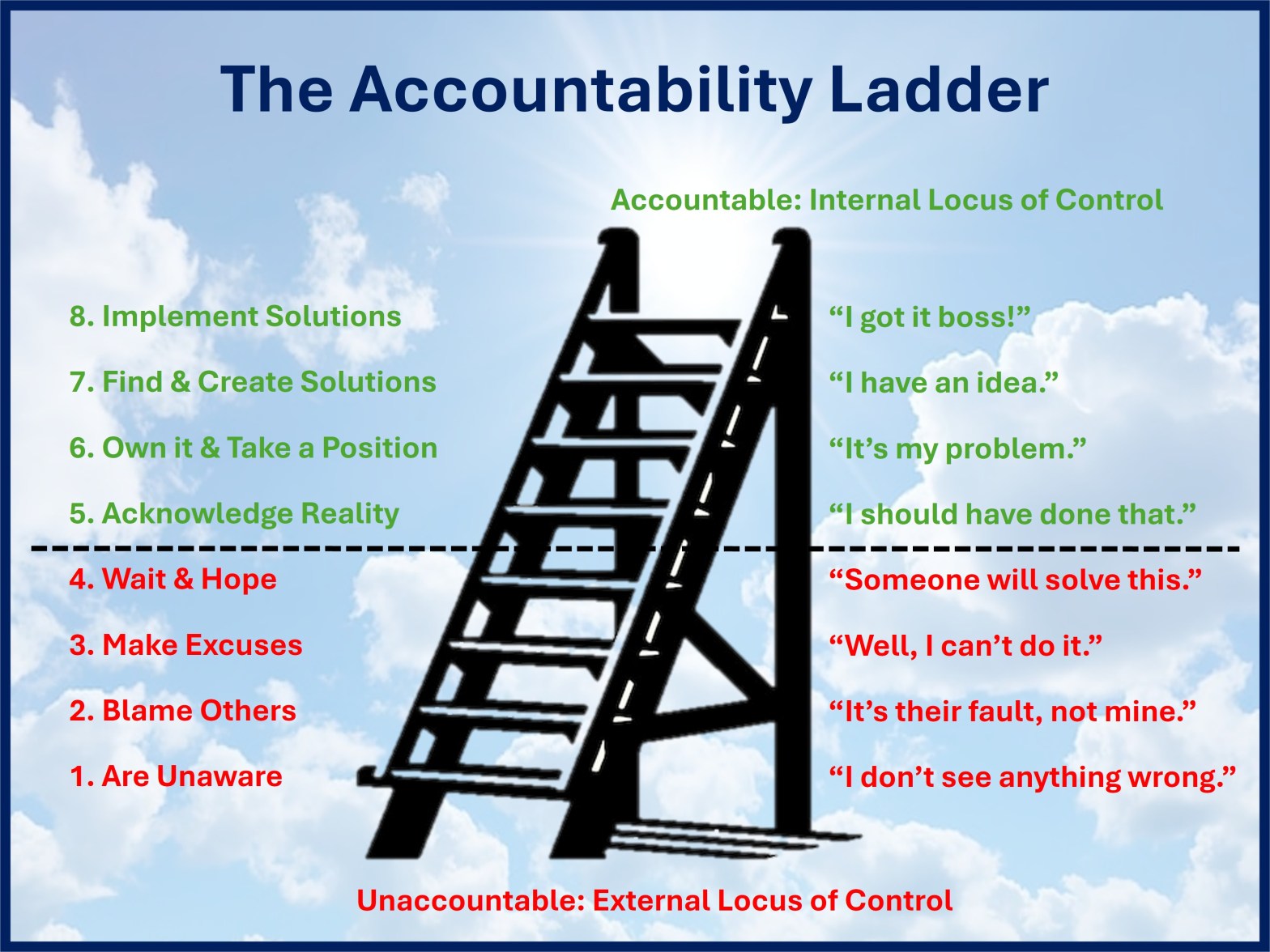
This diverse response demonstrates the accountability ladder theory. Each person has a different level of perceived ownership, ranging from ignorance to solving problems. Our job is to understand where each person is and move ourselves and others further up the ladder.
Climbing the Accountability Ladder
The Accountability Ladder is a tool that helps us identify the extent to which people take ownership of a particular situation. It was developed by Bruce Gordon in 2007 when he was the President of the civil rights organization NAACP.
There are eight steps to the ladder with the top four rungs representing levels of accountability and the bottom four representing levels of being unaccountable. Basically, those who hold themselves accountable live by an internal locus of control, where they believe they control their outcomes and future. Those who fail to hold themselves accountable live by an external locus of control in which they feel they are driven by the environment through no fault of their own.
This ladder helps individuals reflect on their mindset during a project to determine how vested they are in success. A person on Level 1 is considered the least accountable, with Level 8 being the most accountable. Let’s walk through the eight rungs.
Level 1: Are Unaware. This person fails to even acknowledge that there’s a problem. They are either uninformed or disinterested in the project and in the success of the team. These people use phrases like, “I don’t see anything wrong,” “I didn’t know,” or “No one ever told me.” At this stage, there is no ownership or initiative. They’re simply along for the ride.
Level 2: Blame Others. At this stage, the person understands there is a problem, but they deny any personal wrongdoing. Everything is the fault of someone else. They have a victim mentality and refuse to admit mistakes. You may hear them say, “It’s their fault, not mine,” and believe others are in the wrong, but not them.
Level 3: Make Excuses. This person also acknowledges there’s a problem but will make excuses as to why it wasn’t their fault. It gets back to poor guidance, old processes, lack of communication, inadequate resources, or anything but them. “Well, I can’t do it,” is their mantra and instead of looking for solutions, they look for excuses.
Level 4: Wait and Hope. Here, the person is aware of the situation and wants it to get better, but they’re not willing to do anything about it. With teammates around, they think, “Someone will solve this,” but it won’t be them. The good news is they aren’t making excuses, but the bad news is they won’t take action. They will sit there, admire the problem, and hope someone takes care of it.
Levels 1 through 4 are considered the unaccountable stages where the external locus of control makes them feel like victims and powerless to take action. Levels 5 through 8 are stages where the individual feels an internal locus of control. They are empowered to take action and accountable for the success or failure of the project.
Level 5: Acknowledge Reality. This is a critical crossover mentality from victim to champion. Here, the person accepts reality and their part in the situation. They accept responsibility for what went wrong and stop making excuses. They admit, “I should have done something,” and while they’re not yet solving the problem, they accept ownership of the situation.
Level 6: Own It and Take a Position. Now, this person accepts responsibility and looks to get better. They move from “We have a problem,” to “It’s my problem,” and they’re willing to take steps to solve it. On this rung, no longer is the individual deflecting blame, but instead accepting it and taking steps to avoid the same mistake in the future.
Level 7: Find and Create Solutions. At this stage, the person is no longer waiting to hear problems but has conducted research and says, “I have an idea.” They move from being a problem identifier to a problem solver and actively jump in with new solutions. They are brainstorming and collaborating to make this better. Most importantly, they believe they have the influence to make a difference.
Level 8: Implement Solutions. “I’ve got it, boss!” This person has full accountability of the problem and is already taking action to solve it. They understand they have the authority and ability to take action and are already doing so. They assume full responsibility for the issue and lead others through tangible steps to make things right. These are the ones we want on our team, and most importantly, we want to be like them ourselves.
Why Climb the Ladder?
We’re all on different rungs of the ladder based on the project. A person may be on Level 8 for their capstone project, but have no interest in another area they’re a part of, and be a Level 3 employee. But when people move higher on the ladder, there are a number of benefits:
Increased Problem Solving: The higher we climb, the more we create solutions across the organization.
Stronger Relationships: The most trusted people at work are the ones who don’t blame others and take responsibility for things around them.
Better Team Performance: When everyone is accountable and solving problems, success is happening all around us.
Shift from External to Internal Locus of Control: We want people to be empowered to solve problems; not just feel like they have no control over their lives.
Coaching Up the Ladder
This tool is helpful during individual coaching sessions. When one-on-one, bring out this chart and talk about where our people feel they are on the ladder in various areas. It will be eye-opening and therapeutic to have a common understanding of where they feel empowered and where they feel they’re the victim.
When you have a professional dialogue on accountability within this ladder, you suddenly find root causes for why people are not climbing as high as they could based on their perception in the workplace. Taking time to understand their point of view is critical to reducing obstacles in their path and moving them up the ladder.
Climb High
This ladder is a window to the soul that we can use on ourselves and others. Each time we climb another step, we have the ability to take more control of our lives and solve problems with the help of others. And any time we can understand where our people are on the ladder, have a conversation on why they are there, and encourage them to climb higher, we are making our organization better.
Accountability is about taking responsibility for ourselves, others, and our results. Let’s ask next time we want to throw out an excuse, which rung are we on, and whether we need to climb higher to be the most effective leader our people need.
Click here to sign up for The Maximum Standard’s weekly email where you’ll get a leadership vignette delivered for free every Tuesday morning!
We’re always looking for authors. We coach first time authors (and anyone) through the writing process if you need a little help. It’s worth taking the first step to get published.
This website is a personal blog and all writings, podcasts, opinions, and posts are the authors’ own and do not represent the views of the United States Army nor any other organization. Podcast music credit in this audio file is to: “Alex Productions – Legends” is under a Creative Commons license (CC BY 3.0). / @alexproductionsnocopyright
 The Maximum Standard