February 17, 2026
by Stephen T. Messenger
For as long as I can remember at work, I’ve been eating at my desk. Lunchtime comes around, and I hit the community kitchen, throw some leftovers in the microwave, head back to my office, and chow down while continuing to be productive. As a model employee, work stops for nothing, not even food.
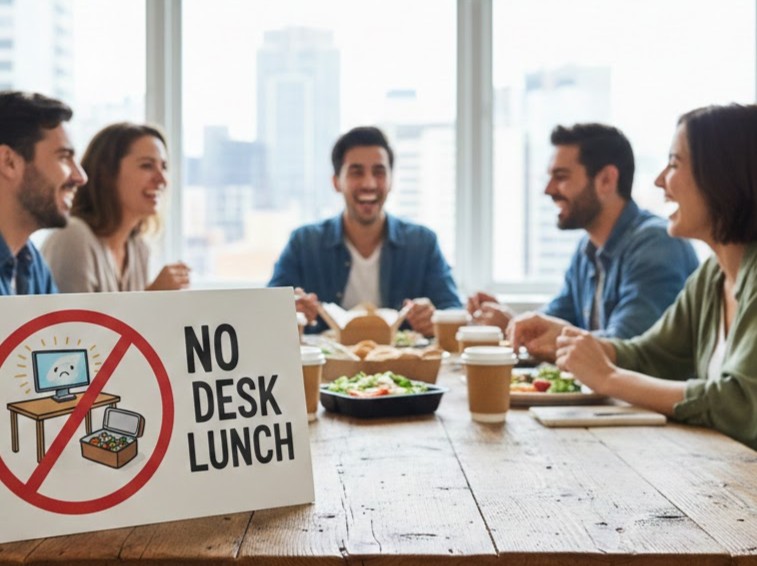
This year, I tried something different. Every day at noon, I ask people around me to grab lunch and fellowship for 30 minutes. The rallying cry: Never eat lunch at your desk.
In this experiment, I’ve found that having a group lunch every day does three things. It builds interoffice relationships, increases happiness levels, and makes us more productive.
Breaking Bread Builds Bonds
In 1938, Harvard began a study tracking 268 sophomores and continued to follow them for over 80 years. Now known as the Harvard Study of Adult Development, researchers studied physical and mental health, following the subjects and their descendants to assess human behavior. What they found was fascinating.
Good relationships keep us happier and healthier. Period. More than wealth, IQ, or social class, the quality of close relationships predicted long-term health and life satisfaction.
For decades, my lunch relationship was with my computer and work. This year, it’s about the people I work with. We have somewhere between three and ten people attend each day, and we share stories of our kids, weekends, and lives. We sometimes learn more about each other in 30 minutes than we learn in a month of passing each other in the hallways.
The stories are funny, emotional, exciting, and entertaining. We’ve talked about restaurants, vacations, jokes, and fails. In that short window, we’ve grown together as a team and enjoyed each other’s company.
But the biggest benefit of our “family lunches” is that we build trust with each other that has grown exponentially over these half hour periods. And that trust doesn’t stay at the table, it expands into the rest of the day in the forms of collaboration and decision-making.
Shared Supper Sparks Satisfaction
The 2025 World Happiness Report has been studying social connections for over a decade. They have determined that sharing meals has a direct correlation to the levels of happiness in individuals. Across 142 countries, they’ve studied countries that share almost every meal with others and countries that habitually eat alone.
The results show that community meals are a high indicator of well-being. Those who break bread with others state a higher level of life satisfaction than those who eat alone. These results transcend income levels, age, gender, and country. Yet in America, one in four people reported eating every meal alone the day before the survey.
I’ve noticed that immediately following our group meals, I am in a much better mood. I just spent time with my work friends, laughed, and escaped the daily grind of work. My mood increased, my social capital went up, and I enjoyed time recharging for the second half of the day.
Coupled with building relationships, community lunches increase happiness in people and communities. It not only raises individual-level satisfaction, but group happiness as well, which continues into the workday.
Team Tables Turbocharge Throughput
A 2015 study from Cornell University’s Dyson School found an increase in productivity from teams who ate meals together. They surveyed 50 firehouses over 15 months and found significant differences between those teams who ate together and those teams who didn’t. Notably, the group lunches created networking and social opportunities that increased morale and success at work.
But it expands beyond the firehouse. Columbia University found that families who eat dinner together five or more times per week have kids who do better academically, eat healthier, and have fewer behavioral problems than those who do not. This directly correlates to the workplace as shared bonds increase performance within teams.
I’ve found that taking a dedicated 30 minutes for lunch with friends helps me be more productive. It gives my brain a mental retreat to relax and refresh for the afternoon’s work. I’m more mentally alert after eating than if I were to work straight through lunch to burnout. Finally, the trust we build while hanging out directly correlates to our work, improving teamwork and engagement levels.
Our brains were not made to work continuously. Taking a break allows us to mentally reset and prepare for the second half of the day, while building bonds to work more effectively as a team.
Communal Cuisine Cultivates Culture
I used to think that working during lunch was making me more productive. What I’ve learned is that it was making me less so.
By stepping away from our desks and breaking bread together, we strengthen relationships, increase happiness, and become more productive. While it often seems counterintuitive, pausing for lunch is one of the great work hacks that costs nothing and gives everything.
Next lunch, knock on some doors and invite coworkers to a standing lunch date. You’ll be surprised at the immediate return on investment, and how much it lasts.
Click here to sign up for The Maximum Standard’s weekly email where you’ll get a leadership vignette delivered for free every Tuesday morning!
We’re always looking for authors. We coach first time authors (and anyone) through the writing process if you need a little help. It’s worth taking the first step to get published.
This website is a personal blog and all writings, podcasts, opinions, and posts are the authors’ own and do not represent the views of the United States Army nor any other organization. Podcast music credit in this audio file is to: “Alex Productions – Legends” is under a Creative Commons license (CC BY 3.0). / @alexproductionsnocopyright
 The Maximum Standard