February 24, 2026
by Stephen T. Messenger
For 18 months, I’ve been working hard on improving my sleep. There’s just one problem. When I want to sleep, my family is up. When I’m up, my family wants to sleep. The frustrating part is that my kids are most engaging right around 10 p.m., the same time I’m least engaging.
After some careful study, I’ve realized that we’re on different sleep cycles. It’s the reason why I’m an early riser, and they’re night owls. When the two don’t match up, there’s friction.
Even worse, if we don’t understand our own circadian rhythms, we could be trying to be productive when our bodies are fighting us. The tension is real… and real disruptive.
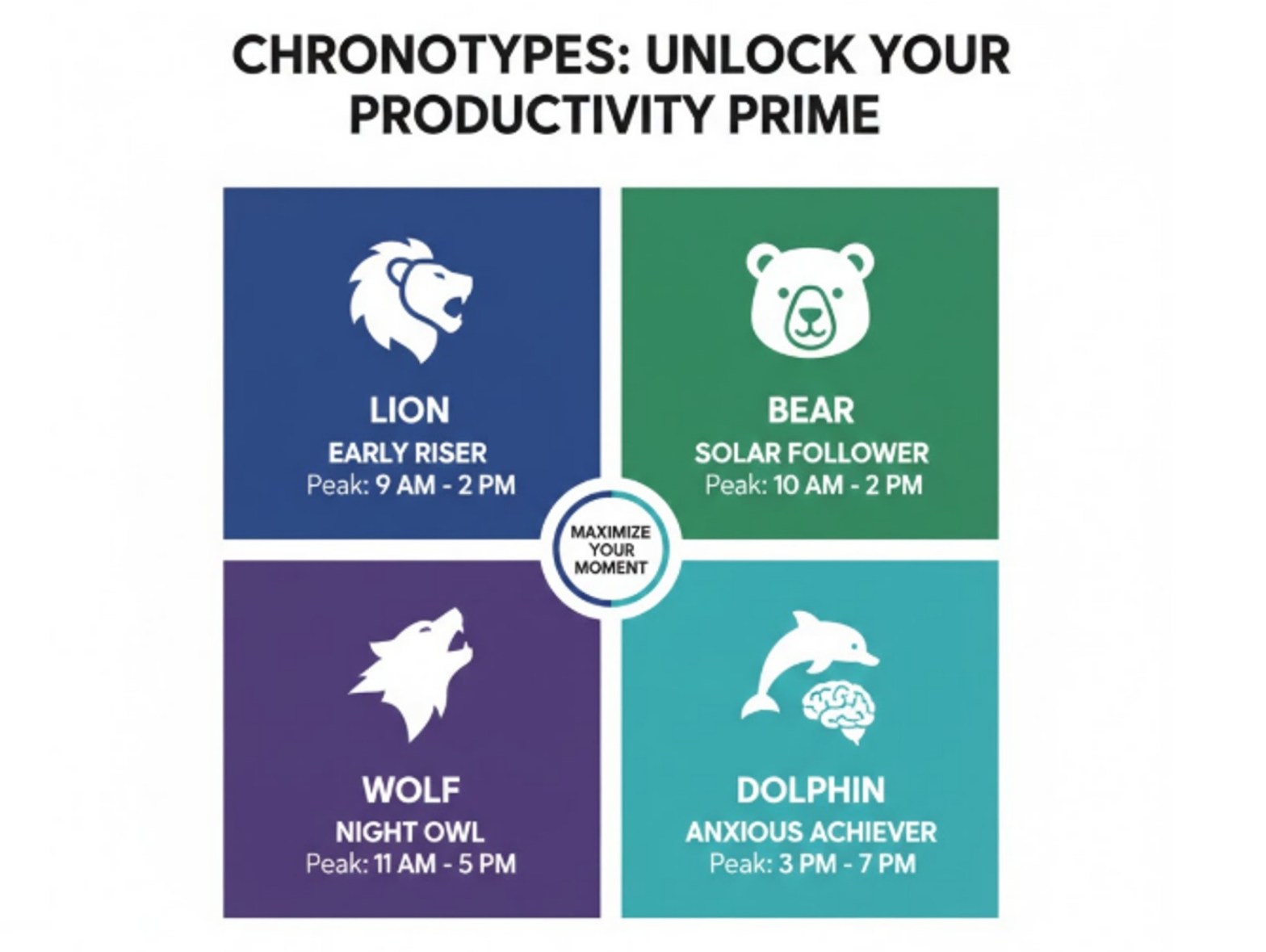
That’s why it is so important to understand the chronotype of our bodies. A chronotype is the natural inclination that we all have to sleep, eat, exercise, and engage best during certain parts of the day. If we understand our type, we have a better chance of managing our day based on our strengths. There are generally four categories of chronotypes: the lion, bear, wolf, and dolphin, and knowing our type will improve our productivity.
Chronotypes Matter
Dr. Michael Breus of the American Board of Sleep Medicine has studied sleep patterns for years. He developed a theory that there are four chronotype categories where each individual is genetically programmed to sleep at certain times. We’ve probably heard the two general categories where we’re either a morning person or a night owl. In reality, these choices aren’t binary but fall within a scale.
If we can understand when our bodies naturally want to sleep and work, we have a better chance of leveraging our expected rhythms to be productive at the right times. The U.S. Army believes so strongly in the value of sleep that they made it one of its five principles of Holistic Health and Fitness.
While we may not always be able to stick to these cycles, knowing where we best perform can help us during normal schedules to maximize our time. During disrupted schedules, we’re at least aware of how the changes in sleep are affecting our productivity. The four categories that Dr. Breus developed can inform this thinking.
Lions. These types of people do their best work in the morning. Lions hunt early and get things done first. They are optimistic, disciplined, and regimented. My profession, the military, loves lions. They go to bed early, wake up early, and work out early. In the mornings, lions are energized and sociable, ready to tackle the day like hunting a wildebeest.
Lions have an increased chance of healthy heart fitness, proper weight, and mental health. Approximately 15% of the population are lions. They’re most productive waking up around 6, focusing best between 9 a.m. and 2 p.m., and going to bed early around 10 p.m., on time, with no regrets.
Bears. This chronotype follows the solar patterns. When the sun rises, so do they. When the sun sets, they call it a day. Society roughly follows the pattern of the bear with work schedules, eating times, and social interactions. Bears can maintain the typical 9 to 5 office hours and still hang out in the evenings. Basically, they match expected norms.
However, bears have a tendency to carry sleep debt. They lack sleep during the weekdays and hibernate or sleep in on weekends. This creates a challenge in health with them often experiencing weight issues. They wake around 7 a.m., are most productive from 10 a.m. to 2 p.m., and turn in around 11 p.m. They’re also the most common chronotype with 55% of all people being bears.
Wolves. This type is the late-night crew. Wolves are nighttime hunters and nocturnal beings. They are creative, find new experiences, and take risks. They wake up later than the other two animals and go to bed much later. Their rhythms don’t match society, so they’re always groggy for morning work and school while socializing well into the night
About 15% of the population are wolves. They wake up with just enough time to make it to work (7:30 a.m.), reach peak productivity between 1 p.m. and 5 p.m., and go to bed at midnight. They often don’t get enough sleep, which can impact their health. This cycle creates problems linking up with societal norms.
Dolphins. This last type are ones whose brains are running wild even when it’s nighttime. Like the aquatic mammal, half their brain keeps thinking while the other half is sleeping poorly. Their nervous energy at night prevents them from fully resting, and they’re alert while trying to sleep because of a non-standard pattern of increased nighttime brain activity.
About 10% of people are dolphins. They wake up early, say 6 a.m., go to bed late around 11 p.m., and are most productive between 3 p.m. to 7 p.m. In the morning, when everyone else is ramping up for the day, they are crashing. However, this type is intelligent and focused on details, albeit often anxious.
No One Size Fits All
Remember, these are models and few people cleanly fit into these exact types. But what is clear from science is that most of us need about seven hours of sleep every night. For lions, it’s easier to power down and go to bed early to wake up early. For wolves, that means understanding that work or school may require an early rise, which could be a challenge to those night people.
It’s hard to change our chronotype. But it’s easier to train our circadian rhythm, or our sleep cycle, by when we sleep and rise. The key is to match our chronotype to our circadian rhythm to the times we need to be most productive while getting our full complement of sleep. If we can manage those four pieces, we’ll be more alert, productive, and engaged at the right times.
Keep in mind also that our chronotype also shifts over our lives. Young children start as lions, going to bed early but needing more sleep than adults. As teenagers, they shift to wolves, staying up late and often having to be dragged out of bed in the mornings (you parents get me). Then in adulthood, they settle into their genetically influenced type. As an older adult, they often revert back to lions, hence the early-bird specials for dinner.
Managing our Sleep
So when we know our sleep patterns and compare them to when we need to be most alert, we can now take steps to be more productive. First, our work schedule probably isn’t going to change, but the times when we need to be most “on” might. If we can schedule our toughest mental work when we’re most alert, our brains will perform better.
Second, know there are certain associations between our sleep type and how we act. Morning people are often better with standardized school material while wolves are usually wired more for creativity. Evening people often struggle to have a consistent sleep schedule resulting in grogginess, while lions lack social energy at evening events. If we know we have certain requirements, we can occasionally adjust our sleep to meet them.
Finally, other things may be affecting our sleep. Caffeine, alcohol, sugar, meal timing, late-night screen time, and workout schedules can all affect our sleep. It’s important to match our intake to our rhythms with our chronotype to be most productive. What we feed our bodies physically and mentally matters greatly.
Own Our Animal
Know yourself and know your enemy and you will be successful in 1,000 battles, says Chinese Philosopher Sun Tzu. I’m more of a lion myself, and here I am at 11 p.m. finishing up this article. I can feel my brain working slower and my body wanting to bail. It’s a perfect case study on what not to do.
The next day: In contrast, as I review this in the morning, I can tell I’m sharper, clearer, and write more better(er). I know this because this morning edit cleaned up a lot of evening nonsense that I typed.
The key is to own our animal. Being a lion, bear, wolf, or dolphin is not good or bad, it just is. And if we know how to engage our bodies with our world, we can harness the power of sleep and productivity to be incredibly successful.
Click here to sign up for The Maximum Standard’s weekly email where you’ll get a leadership vignette delivered for free every Tuesday morning!
We’re always looking for authors. We coach first time authors (and anyone) through the writing process if you need a little help. It’s worth taking the first step to get published.
This website is a personal blog and all writings, podcasts, opinions, and posts are the authors’ own and do not represent the views of the United States Army nor any other organization. Podcast music credit in this audio file is to: “Alex Productions – Legends” is under a Creative Commons license (CC BY 3.0). / @alexproductionsnocopyright
 The Maximum Standard