February 26, 2026
by Jerel Foster
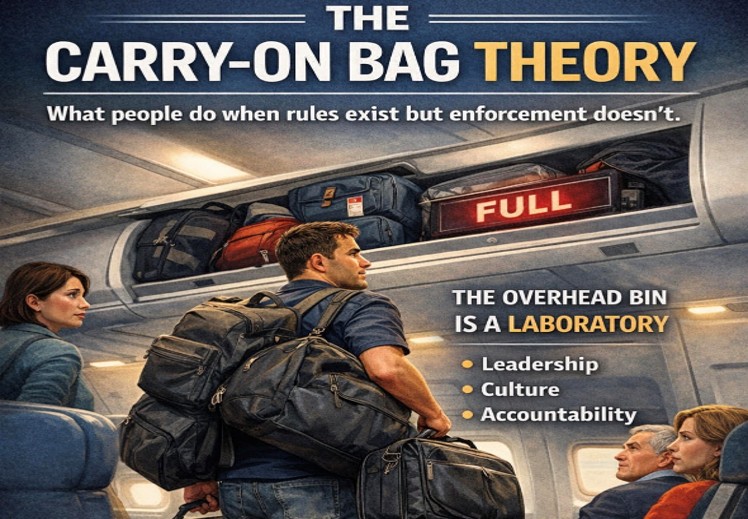
If we really want to understand human behavior, we can skip the personality tests entirely. We just need to stand at an airport gate for about twenty minutes and watch.
Specifically, we should watch the passenger boarding with four bags while confidently insisting, “This is my personal item.” Not “these are my personal items.” Singular, not plural. As if the carry-on bag, the backpack, the shopping tote, and the winter coat stuffed to the absolute structural limits of what a small suitcase can endure have somehow achieved a kind of metaphysical unity through sheer audacity, one noble, singular object, born of ambition and a deep unwillingness to pay a checked-bag fee.
Welcome to The Carry-On Bag Theory: the spiritual successor to the Shopping Cart Theory, now upgraded with wheels, TSA PreCheck, and a remarkable, almost athletic capacity for self-deception.
A Behavioral Classic, Reimagined
The Shopping Cart Theory, for those not yet initiated into its elegant gospel, is beautifully simple. Returning a cart to its corral reveals our capacity for self-governance. There is no reward for doing it and no punishment for abandoning it to careen freely across the parking lot toward a stranger’s Camry. There is only a choice, one that benefits strangers at a minor inconvenience to us. Behavioral scientists love it precisely because it is a litmus test conducted in the wild, without a laboratory, without a clipboard, and without anyone watching.
When there are no consequences either way, what do we do? Do we leave the cart where it stands, knowing full well it will eventually slam into a stranger’s car during a windstorm, or do we walk thirty extra feet because civilization, it turns out, requires occasional effort from all of us? That is the whole theory. It is almost annoyingly pure in its simplicity.
The airport, however, offers something considerably richer. It offers a full masterclass in rationalization under pressure, observed in real time with a captive audience.
Why Airports Expose Our True Nature
Airports are, in the most literal sense, petri dishes for behavioral observation. They combine everything psychologists dream about in a single teeming environment: high stress, ambiguous enforcement, time scarcity, and several hundred strangers we will almost certainly never see again. It is anonymity with consequences, just not consequences for us, personally. Instead, the penalties accrue quietly to everyone else.
Research in behavioral economics confirms what every exhausted gate agent already knows in their bones. When rules exist but enforcement is sporadic, and when resources feel scarce, humans optimize reliably for personal advantage over collective efficiency. A 2018 study published in Psychological Science found that perceived scarcity, whether real or merely imagined, triggers self-interested behavior even among people who, under perfectly normal circumstances, hold doors open and say “excuse me” when their cart bumps ours in the cereal aisle. Strip away the social fabric, add a departure board, and apparently all bets are off.
Enter the carry-on bag. Or bags. Plural. Many, many bags.
The Carry-On Bag Spectrum: A Taxonomy
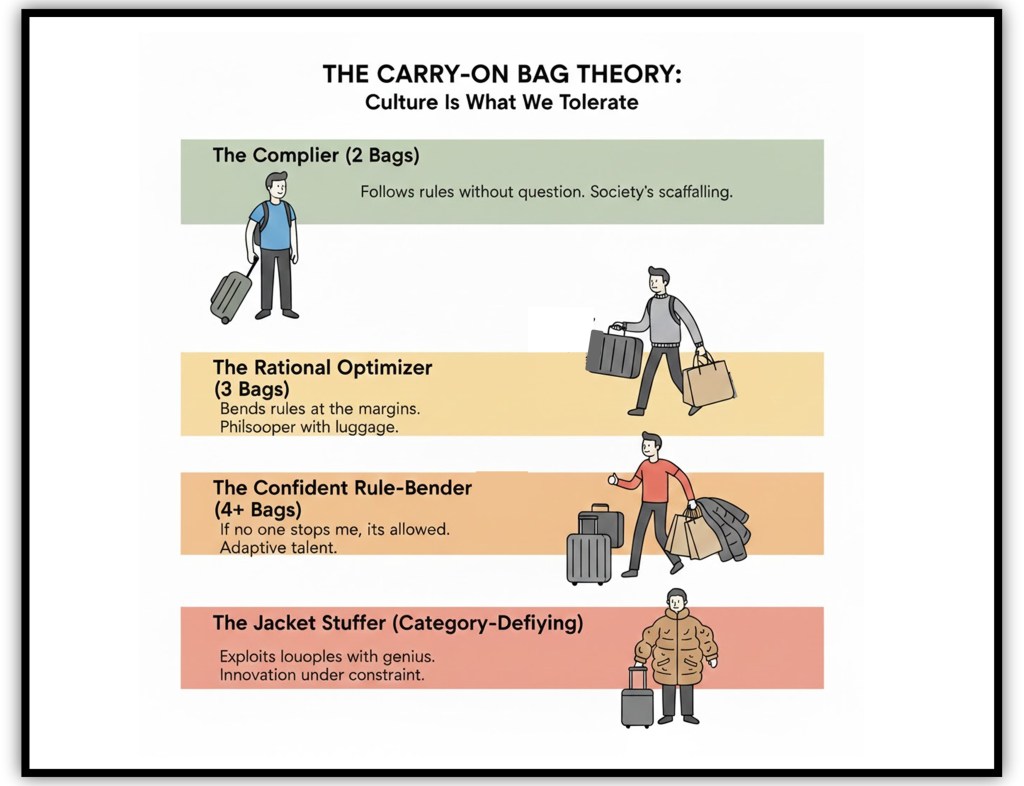
Most travelers fall into predictable behavioral categories, each one revealing something genuinely illuminating about how we navigate rules when personal convenience and institutional compliance happen to collide in the boarding zone.
The Complier (2 Bags)
This person follows posted regulations without negotiation, without sighing, and without any visible inner turmoil. One carry-on, one personal item, both comfortably within dimensional guidelines. They move through the boarding process like a well-oiled machine, finding their seat, stowing their bag, and settling in before the rest of us have finished arguing with ourselves about whether the gate agent will notice the second tote. These people almost certainly return shopping carts, tip twenty percent without calculating whether the service merited it, and have never once in their lives thought, “I could probably get away with this.” They are the scaffolding of society. We do not deserve them.
The Rational Optimizer (3 Bags)
This group understands the rules thoroughly and has studied, with some dedication, exactly how far they bend before snapping. They know that “personal item” is subject to interpretation, that gate agents are exhausted by hour six of their shift, and that if we board confidently enough and with sufficient forward momentum, no one will challenge the tote bag that is, technically speaking, a small piece of carry-on luggage wearing the clothing of a tote bag. This traveler has run the cost-benefit analysis and determined that the roughly eight percent chance of being asked to gate-check is an acceptable trade-off for the convenience of keeping everything within arm’s reach. They are not breaking rules, exactly. They are exploring definitional boundaries, like a philosopher, but with more carry-ons.
The Confident Rule-Bender (4+ Bags)
This traveler operates on a philosophy that is, in its own way, admirably straightforward: if no one stops me, it is allowed. They board with a carry-on, a backpack, a duty-free shopping bag still in its crinkly branded paper, and a jacket so overstuffed it has crossed the invisible threshold into soft-sided luggage territory. And here is the thing. This is not necessarily entitlement, at least not in the theatrical, villainous sense. It is adaptive behavior, emerging entirely predictably under weak enforcement systems. When violations go unchallenged, they calcify into precedent. What was once brazen becomes, through simple repetition, normalized. The rule-bender did not create this dynamic. They merely recognized it and acted accordingly, which is its own kind of depressing talent.
The Jacket Stuffer (Category-Defying)
The Stuffer deserves their own anthropological study, possibly their own chapter in a textbook. They are wearing a jacket in a climate-controlled terminal; a perfectly comfortable, sixty-eight degree terminal, and that jacket contains a laptop, two charging cables, a Kindle, noise-canceling headphones, a water bottle, three granola bars, and a hardcover book. Are they breaking the rules? Technically, no. Are they exploiting a loophole with the sophistication of a tax attorney who moonlights in aerospace engineering? Absolutely. From a purely behavioral standpoint, this is innovation under constraint. The same fundamental impulse that once led humans to invent the wheel is now applied with equal ingenuity to avoiding a thirty-five-dollar checked-bag fee.
The Science Behind the Overhead Bin Wars
Here is where the satire and the sociology become genuinely indistinguishable. Studies on social norms, particularly the research of behavioral economist Dan Ariely at Duke University, demonstrate that when violations go unchallenged, they normalize with startling speed. Observing someone else break a rule makes us statistically more likely to break it ourselves, as though rule-bending is mildly contagious. What begins as an individual exception, one bold four-bag pioneer on a Tuesday afternoon flight, gradually becomes a collective expectation shared by entire boarding zones.
The downstream effects of this are familiar to anyone who has ever boarded a full flight. Overhead bins fill before half the plane has even reached the jetway. Boarding processes slow to what can only be described as a Sisyphean crawl, with each successive passenger performing an increasingly elaborate bin-Tetris routine. Gate agents are forced into reactive, exhausting enforcement mode, doing crowd control for a problem the system itself created. And the people who actually followed the rules, the Compliers, bless them, end up gate-checking their properly sized, regulation-compliant bags while the four-bag traveler settles in comfortably overhead, feet from the front.
Just like abandoned shopping carts, the cost is distributed evenly across everyone, but it is never paid by the individual who caused it. The tragedy is not that some people game the system. The tragedy is that the system rewards them for doing so, consistently and without consequence, which is a fairly efficient way to teach everyone else that the rules are optional.
What the Carry-On Bag Theory Really Reveals
This theory is not about luggage, any more than the Shopping Cart Theory was ever really about grocery stores. It is about what happens when personal convenience conflicts with shared responsibility, and no one is watching closely enough to intervene. It is about the gap between written rules and enforced norms, between what we say the standards are and what we actually allow to happen on a Tuesday afternoon in Terminal C. It is about how quickly the concepts of “allowed” and “unchallenged” become functionally indistinguishable in the human mind, a merger that happens quietly, without announcement, and with remarkable efficiency.
The same dynamics surface everywhere we look, once we know what to look for. Corporate expense policies, where a working dinner for two becomes a business dinner for six because no one ever audits the receipts with any real intent. Traffic behavior, where the gap between the posted speed limit and the speed everyone actually drives has widened to a comfortable fifteen miles per hour that no one discusses. Workplace accountability, where “I didn’t see that email” has become a socially acceptable explanation for missed deadlines. Systems do not fail because of bad actors in the dramatic, mustache-twirling sense. They fail when the incentive structure rewards rule-bending over cooperation, when convenience consistently trumps consideration, and when individual benefits quietly accrue while collective costs compound in the background: invisible, unattributed, and growing.
For Leaders: Culture Is What We Tolerate
For anyone responsible for organizational culture whether running a Fortune 500 company, a military unit, a school, or a mid-sized regional airline with chronic overhead-bin problems, the Carry-On Bag Theory is not merely a metaphor. It functions as a diagnostic tool and a behavioral mirror we can hold up to the systems we oversee.
Culture is not defined by what we write in the handbook, however carefully worded and professionally formatted that handbook may be. Culture is defined by what we consistently allow. When small violations go unchallenged, we are not simply permitting individual instances of minor rule-bending. We are actively normalizing a pattern. We are teaching the people around us that the rules are negotiable, that enforcement is sporadic, and that the system, on balance, rewards those willing to push the boundaries furthest. That is a curriculum, even if we never intended to teach it.
High-performing organizations are the kind that execute well under genuine pressure. They do not rely on constant policing to maintain standards. They design environments where doing the right thing is expected, visible, and reinforced by the culture itself, and where the social cost of bending the rules quietly outweighs the personal convenience of doing so. Discipline at the margins, in the small, unglamorous, easily-ignored moments, ends up determining success at scale. Because whether we are boarding a plane or executing a complex operation, the small stuff is never really small. It is a preview, a dress rehearsal, and a reliable indicator of exactly what will happen when the stakes get considerably higher.
Final Boarding Call
The shopping cart did not disappear, of course. It evolved, as things do. It now has wheels, fits overhead when circumstances align favorably, and quietly reveals, to anyone paying attention, how we navigate shared spaces when accountability is optional, the bins are finite, and everyone else is simply trying to get home.
So next time we find ourselves at the gate, it is worth taking a moment to watch the bags. Notice who boards with two, and who boards with four, and who boards wearing a jacket in July that somehow weighs fifteen pounds and clinks faintly when they walk. We will learn a remarkable amount, not just about air travel and not just about the eternal human struggle against the checked-bag fee, but about human nature itself when the rules are soft, the overhead bins are closing fast, and no one appears to be watching very carefully.
And maybe, just maybe, we will think twice before convincing ourselves that the purse, the laptop bag, and the shopping tote taken together are technically one personal item. Or maybe we won’t. That’s the theory.
Jerel B. Foster is a retired Command Sergeant Major with over three decades of leadership, having commanded and guided high-performing teams in some of the most demanding operational environments in the world. Rooted in the stoic belief that true leadership is forged through discipline, resilience, and unwavering service to others, he has dedicated his career to developing unbreakable leaders and building organizations that endure under pressure. Jerel, now channels that same ethos into his work as an operations executive, strategist, and mentor backed by a lifetime of earned experience. www.linkedin.com/in/jerel-b-foster
We’re always looking for authors. We coach first time authors (and anyone) through the writing process if you need a little help. It’s worth taking the first step to get published. Click the link in this paragraph to start your writing journey with us!
 The Maximum Standard