March 3, 2026
by Stephen T. Messenger
I found myself again sitting in yet another routinely scheduled team meeting that wasn’t going anywhere. I looked around at the faces of the bored participants, each questioning their life choices of attending this worthless event. Some were half paying attention. Some weren’t even pretending at this point. Others were checking their phones in (not so) secret as we waited for two strong personalities to talk about a very specific topic that only applied to them. You’ve been there.
This type of meeting is the death of organizational efficiency. Yet, they happen countless times across our workplaces destroying unimaginable hours of productivity. Actually, someone has done the math. There are over 55 million meetings each week in America. Organizations spend on average 15% of their time in these sessions, and employees report that only 11% of that time is actually productive.
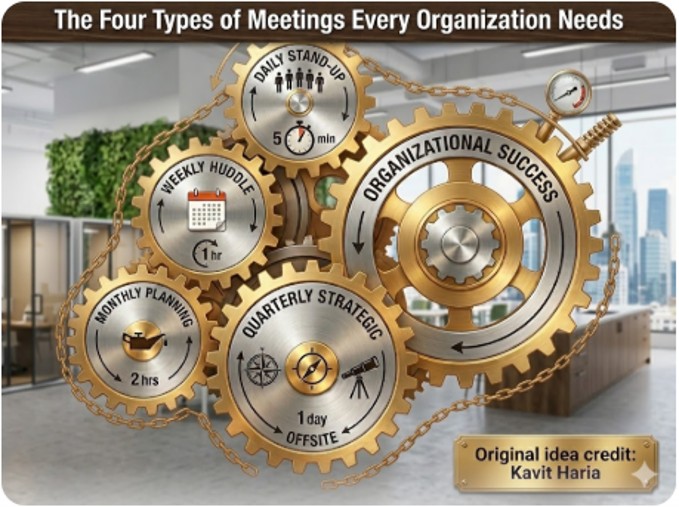
The problem may be too many meetings, yes, but we should focus on increasing that 11% of reported non-productive time. That could mean eliminating them. But better, it certainly means making each gathering more useful to employees. To do so, we should focus on four core meetings that every organization needs, adapted from Kavit Haria with my spin on it.
Needs Versus Wants
My son likes to challenge me on a need versus a want. He often quips that, “You do not need it. You want it.” This is the same with many of our meetings. We don’t need them. We want them, or at least feel compelled to do them. Yet our employees do not.
Our job as meeting organizers is to get to a space where our people both need the meeting and want to be there. It takes effort, but by ruthlessly planning our meetings, we can make them both a need and a want.
To get there, we must do three things. First, establish a predictable meeting rhythm where everyone knows where to be, how often, and why they are there. Second, have a clear purpose and agenda for every engagement. Finally, have an ending point where we never go long, and often go short. By focusing on these three simple items, we can raise the reported level of engagement by our employees.
The Four Horsemen of the Meeting Schedule
Organizations thrive on predictability. There is a reason the expression, “running like a finely tuned engine,” exists. Because when all parts are working as they should, the engine of our organization works greatly. When we throw a wrench into it, the place literally seizes up. That’s why having a predictable rhythm of events is crucial to any group of people. These four meetings will help us do that.
Daily Stand Up (5 minutes)
The first thing we need is a daily touchpoint. This meeting is like starting our car every morning to make sure it runs before we drive it. While many people start rolling their eyes when they hear “stand ups,” this event is crucial for people to come together, update on yesterday’s events, note any emergencies, and drive on with the day. Each person has a voice to discuss any items of interest to the group.
The intent is to keep it quick, hence standing up. If it’s more than five minutes total, we’ve talked too long. If something is important to one or two people, they can huddle after, and everyone else goes back to work with known priorities, a face-to-face to build relationships, and a motivated “thank you” for everything they do. Keep it quick, simple, and motivating.
Weekly Huddle (1 hour)
The second meeting we need is a tactical meeting to make sure the tires have air and there’s gas in the tank to drive the organization effectively. In these meetings, we focus on the next two to three weeks. It’s how we plan for the near term and keep everyone aligned to the priorities of the collective team.
We relentlessly focus on what items are important for multi-day execution. It’s about identifying problems, risks, and tripwires that are on the horizon. Each member of the team should cover their area of expertise and provide an update on what’s happening in their sphere of influence. Everyone gets a voice, and everyone participates.
Monthly Planning (2 hours)
This third type of meeting is like getting an oil change. It’s routine maintenance to correct any deficiencies so the organization will run smoothly over the next few months. The planners look at the big picture. They think about how all the moving parts fit together to cover the equities of the group. These meetings are about long-term thinking and success and everyone there should have a voice.
This is our chance to see how all the parts fit together and tackle the most pressing matters, many of which were identified in the weekly huddles. We have a focused agenda going in and work on two or three major topics each month. Using divergent and then convergent thinking, we always come back to solutions and assign a project lead for the next steps.
Quarterly Strategic (1 day)
This final meeting is about long-term planning and strategy. Here, we go offsite to separate from work for a day and look at the long term. We’re always in a fight to solve today’s problems, which means no one is solving tomorrow’s. This session is a chance to ensure long-term successes are being accomplished without being distracted by daily challenges.
Our job in these meetings is to understand our end states and ensure we have the ways and means to accomplish them long term. It’s about how we shape organizations one, two, and three years from now. Are we meeting our goals? Do we need to reframe? These sessions create shared understanding, build teams, and generate strategic impact. If no one is looking long-term, the future is highly uncertain.
The Power of Meetings
I am convinced that all of us, especially myself, do not harness the full power of meetings to make a significant impact on our organizations. We allow too many of them to have no agenda, get off track, and generate no impact. Moreover, we either allow too many people in the room, or we don’t give the right people in the room a voice.
By relentlessly scheduling our meetings to have deliberate objectives and take individual problems offline, we have to the opportunity to reshape how our meetings help instead of hurt. Too many times, we have them for the sake of having them. Even worse, we schedule most meetings for an hour, when many could be much shorter… or an email.
Meetings are actually a tremendous enabler when used right. Yet they’ve gotten a bad reputation based on how we conduct them. By reframing our schedules to adhere to the four types of meetings, we can eliminate wasted time and energy. When we align our meetings properly, we can increase our morale, productivity, and desire to sit in more meetings.
Leave them wanting more! Not less!
Click here to sign up for The Maximum Standard’s weekly email where you’ll get a leadership vignette delivered for free every Tuesday morning!
We’re always looking for authors. We coach first time authors (and anyone) through the writing process if you need a little help. It’s worth taking the first step to get published.
This website is a personal blog and all writings, podcasts, opinions, and posts are the authors’ own and do not represent the views of the United States Army nor any other organization. Podcast music credit in this audio file is to: “Alex Productions – Legends” is under a Creative Commons license (CC BY 3.0). / @alexproductionsnocopyright
 The Maximum Standard