March 5, 2026
by Joe McAlarnen
I had only been at the Command and Staff College for eight months, working among colleagues whose credibility far predated my arrival. I suddenly found myself operating from a position where I was in charge of a project with no official authority yet leading a cross-functional team filled with intelligent and experienced peers.
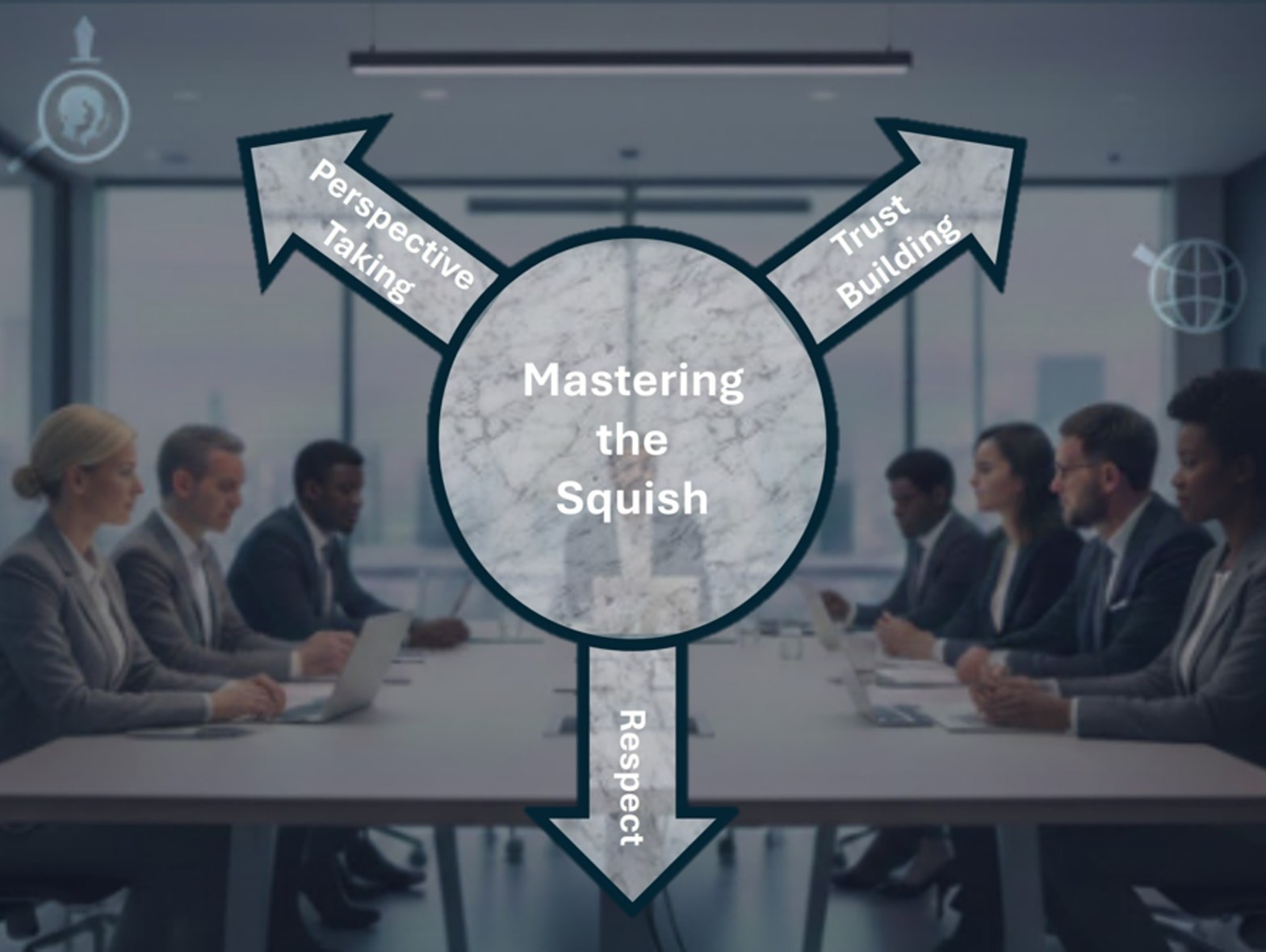
We all find ourselves in positions like this. It’s the space I refer to as the squish: the ambiguous middle where leadership is required, authority is constrained, and influence matters most. Here, traditional hierarchies go out the window, and our command leadership must be replaced by perspective-taking, trust, and respect.
The “What Now” Moment We’ll All Face
My task was to introduce Joint All-Domain Operations (JADO) into Professional Military Education (PME) at scale. A small team had previously implemented an impactful elective, but now we were building it out into a larger program. I looked around the collaboration room; in it were distinguished professors and lieutenant colonels of varied backgrounds. The idea as originally pitched to me came with a warning: it may be perceived as a threat to some of these experts’ life work.
The uncertainty was palpable in their posture and stillness. I could have framed the effort as guidance. I could have focused on process. I could have invoked institutional priority. All of those were true and already understood, but leaning on these concepts to move forward would only heighten the very concerns I needed to mitigate. I laughed inside as the standing Marine Corps phrase from The Basic School echoed in my head, “What now, lieutenant (colonel)?”
When Knife Hands Aren’t Enough
Our dominant concepts of leadership tend to revolve around positional authority within hierarchical organizations. This is readily apparent in military structures but equally visible in the private sector. We picture leaders as those who direct, compel, and evaluate; individuals whose authority is formalized and whose legitimacy is reinforced by structure.
Notably, leadership in these contexts is well studied, taught, and researched. A simple keyword search for “leadership” yields tens of thousands of books, frameworks, and development programs. We intuitively understand this form of leadership because most organizations depend on it to function. Many of us have experienced it directly, applied aspects of it ourselves, or learned to recognize its familiar styles and tools.
But much of today’s consequential work happens outside these familiar structures. It unfolds in spaces where authority is less defined, peers are empowered, cultures intersect, and directive tools carry unintended costs. In these environments, like those found in joint, multinational, academic, interagency, or corporate middle layers, leaders are accountable for outcomes they cannot order into existence.
The Shift to Informal Leadership
Formative military training and continuing education overwhelmingly focus on positional authority, which often centers on command leadership. This is not to discount the importance of this instruction. Rather, it is to offer that regardless of institution, most people spend limited time in command roles; they instead are more often team members or specialist contributors.
Interestingly, I would align the most significant contributions of my own career to informal roles where organizational change or improved multinational partnership occurred through leading collective action. My impact occurred by, with, and through peers, rather than by virtue of positional authority.
Leadership in the squish doesn’t rest on personality or style. It rests on setting the conditions that allow peers, often with varied incentives and identities, to bring their expertise and effort to bear in pursuit of collective gain. Over time, I have found that leadership in these environments hinges on three practices: perspective-taking, trust-building, and respect.
Perspective-taking
Military readers are most likely familiar with the concept of intelligence preparation of the battlefield, or the systematic process of analyzing all variables such as enemy, terrain, and weather to assess the effects on operations. This is how I envision perspective-taking. It is a deliberate effort to understand where each potential contributor is coming from as they join the team. An individual’s experience, cultural frameworks, professional identity, and perceptions of risk all shape how people engage in group dynamics. Bureaucratic position matters as well.
As Miles’s Law suggests, “where you stand depends on where you sit,” and institutional roles are frequently internalized as personal positions. Together, these individual and institutional factors shape what each person brings to the table. Perspective-taking helps the peer leader anticipate friction, reduce resistance, and create conditions for convergence.
Trust-building
Without the ability to compel compliance, peer leaders must rely on trust-building to create conditions that encourage engagement and shared purpose. Research supports this dynamic. In her work on implementation research, Dr. Allison Metz identifies the foundation of equalizing power differentiators as “co-creation and humility.” In practice, trust is reinforced through behavior, such as how individuals run meetings, how disagreements are framed, how input is integrated, and how credit is allocated.
Building trust in these environments requires balancing openness with direction. Leaders must encourage debate while still guiding the group toward both directed and shared objectives. This is complicated by the realities of human behavior: some contribute readily; others hesitate. Yet those quieter voices often hold insights critical to progress. By deliberately drawing them into the conversation while managing dominant voices, peer leaders signal that all contributions matter.
Respect
Underpinning perspective-taking and trust-building is respect. It is the enabling condition that sustains leadership in the squish. Challenging work requires the full engagement of teams, and research consistently shows, such as the 2022 study by Zhao, that respect is central to collaboration and innovation. In practice, this places an imperative on leaders to reinforce the value that each individual’s expertise and prior contributions bring to the collective objective.
Respect becomes especially critical during periods of change, when new approaches can feel like a rejection of past work or professional identity. When transformation is the goal, leaders must take deliberate steps to help team members carry forward into what comes next. Without this effort, resistance hardens. With it, individuals are far more willing to invest in a future they can see themselves in.
From Theory to the Global Stage
I saw these dynamics most clearly not in theory, but in practice. In 2023, one such moment occurred in a collaboration room on the fourth floor of the Multinational Joint Warfare Center in Istanbul, Turkey. Around the table were experts in intelligence, targeting, and operations from multiple nations, services, and organizations.
We shared a common objective: NATO needed a targeting process that would give the Supreme Headquarters Allied Powers Europe (SHAPE) a meaningful way to influence how resources were prioritized. The only way forward was to understand national and organizational perspectives, create trust across professional and cultural lines, and ensure that each participant had a voice in the process.
The Squish Is Where It Happens
Leadership in the squish is rarely visible and often undervalued. It lacks the clarity of command and the simplicity of authority, yet it is where much of today’s consequential work is done. In these spaces, progress is not directive; it is fostered through alignment built on perspective-taking, trust, and respect.
The practices described here are not novel. Most readers will recognize them intuitively. What is different is the context in which they become essential rather than optional. When authority is constrained and outcomes still matter, these practices are no longer stylistic preferences; they become functional requirements for collective action in service of institutional objectives.
In such environments, leadership emerges not from position, but from the ability to create conditions where peers can move forward together. That is the quiet work of leading through the squish, and it is where many leaders will spend far more time than they expect.
Subscribe at the link above to get the newest article in your inbox. The Maximum Standard is ad free and no cost, you can opt out at any time. It’s just leaders helping leaders.
Bio: Joe McAlarnen is a Marine officer who has served on active duty for almost 25 years. He is passionate about his family, Fútbol, Liverpool FC, and Virginia Tech. Find him on LinkedIn at www.linkedin.com/in/joe-mcalarnen.
The views expressed here are the author’s own and do not necessarily reflect those of the United States Marine Corps, Department of the Navy, Department of War or the U.S. Government.
We’re always looking for authors. We coach first time authors (and anyone) through the writing process if you need a little help. It’s worth taking the first step to get published. Click the link in this paragraph to start your writing journey with us!
 The Maximum Standard