March 24, 2026
by Stephen T. Messenger
Dwight D. Eisenhower walked the fields of Gettysburg in 1915 as a cadet attending the U.S. Military Academy. Last weekend, I wandered the same hallowed grounds, learning about and gaining an understanding of the battle in 1863, much as Eisenhower did.
He was participating in a battlefield staff ride, field trips for military professionals meant not to memorize facts, but to understand concepts of war to use them more effectively in the future. While history will never repeat, it often rhymes, a saying commonly attributed to Mark Twain. In this case, Twain could not have been more correct.
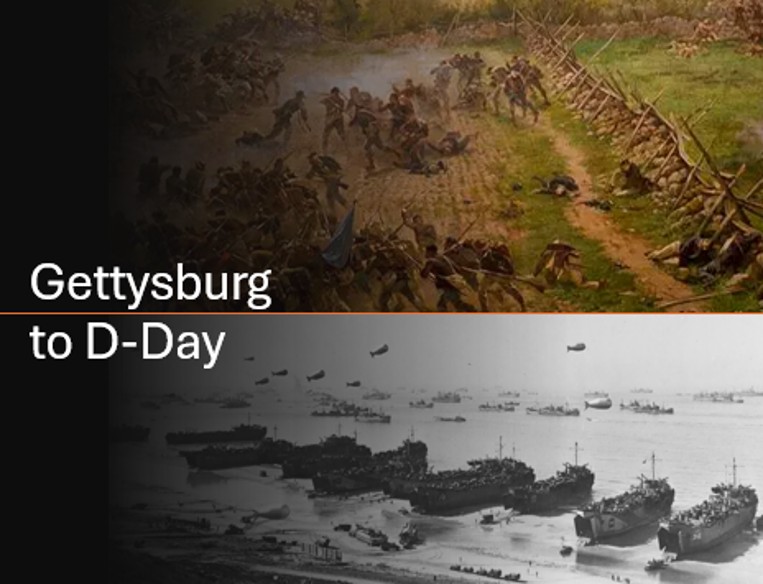
Dwight Eisenhower must have been thinking about Gettysburg in early June of 1944, prior to D-Day. The similarities between what he learned on the battlefield standing at the starting point of Pickett’s Charge and his monumental decision staring across the English Channel to give the go for D-Day had to be rhyming in his head. This is a striking reminder that the study of the past informs our future.
Pickett’s Charge
It was 87 degrees with high humidity on July 3, 1863. Confederate Major General George Pickett stood watching the Union lines almost a mile away, ready and excited to lead his troops into combat for the first time. The two forces stood on opposite ridgelines after fighting for the past two days, both sides hoping for a decisive blow.
General Robert E. Lee’s strategy was to conduct a forward assault of 12,500 men over open terrain and surge against the Union line. It was a bold, audacious plan not supported by some of his subordinate commanders. Yet after a punishing artillery barrage at 1 p.m., the generals gave the order to proceed, and with a Rebel yell, Pickett shouted to his all-Virginian division, “Don’t forget today that you are from Old Virginia!”
What happened next Eisenhower could almost see and smell while standing on the battlefield. I walked the same path as Pickett and Eisenhower across the undulating terrain. It’s easy to see why this was a killing field.
Lieutenant Colonel Franklin Sawyer of the Union 8th Ohio Infantry told of the carnage from his perspective during Pickett’s Charge: “They were at once enveloped in a dense cloud of smoke and dust…Arms, heads, blankets, guns and knapsacks were thrown and tossed in to the clear air…A moan went up from the field, distinctly to be heard amid the storm of battle…”
In the end, the Confederates lost almost half their men, suffering 6,555 casualties in one hour. They retreated back to their lines a shell of their former selves. When Pickett was ordered to reform his division, his response was supposedly: “Sir, I have no division.”
I could imagine a young Eisenhower standing at Gettysburg seeing in his mind’s eye the frontal assault disaster, and reflecting greatly on it. If this were a movie, Cadet Dwight’s young face would be surveying the field, and it would transform to General Eisenhower, Supreme Commander of the Allied Expeditionary Forces in Western Europe, looking across the English Channel on D-Day.
Eisenhower’s Charge
Pickett’s Charge and the D-Day invasion into France rhymed. They both were frontal assaults into a heavily fortified position with divisions of troops just waiting for the signal. In this case, the cadet turned General Eisenhower was having to make the same decision as General Lee did to commit the bulk of his forces into the breach.
But for Eisenhower, this was no longer a theoretical exercise. In 1918, he served as the commander of Camp Colt, a tank training center located on the very same field as Pickett’s Charge. He spent months maneuvering on the same undulating terrain. He knew exactly what it looked like for an attacking force to be exposed to a dug-in defender.
Like Lee, Ike was considering the conditions of his forces and the environment. He had to contend with weather and sea conditions, the readiness of his troops and equipment, pre-assault bombardment, enemy defenses, sustainment, and morale.
Perhaps most pressing, he had to consider the strategic ramifications if D-Day failed. From Gettysburg, I imagine he remembered Robert E. Lee’s quote saying, “this has all been my fault,” and the defeat which led to the demise of the Confederacy. Eisenhower even drafted a letter in the event of failure:
“Our landings in the Cherbourg-Havre area have failed to gain a satisfactory foothold and I have withdrawn the troops. My decision to attack at this time and place was based upon the best information available. The troops, the air, and the Navy did all that bravery and devotion to duty could do. If any blame or fault attaches to the attempt it is mine alone.”
This language is very Lee-esque. The gravity of this decision and the ghosts of Gettysburg had to be weighing on him. From a historical perspective and a failed Pickett’s Charge, perhaps the right decision was to delay or fight another day on another ground. But victory often goes to the bold.
Eisenhower knew the Gettysburg staff ride was informative of history but not directive of the future. I see him using the lessons from Pickett’s Charge to mitigate Lee’s mistakes. Lee lacked reliable intelligence, conducted an overt frontal assault, and used underwhelming artillery support, among other issues. Eisenhower used deception, darkness, distraction, bombardment, intelligence, and overwhelming logistics support to correct some of Lee’s mistakes.
Finally, once the plans were in place, he made the best decision he could when he approved the order with a simple, “OK, we’ll go.”
The Past Rhymes with the Future
General James Mattis said about learning from the past: “If you haven’t read hundreds of books, you are functionally illiterate, and you will be incompetent, because your personal experiences alone aren’t broad enough to sustain you.” Eisenhower probably didn’t understand that as a cadet at Gettysburg, but he did as a four-star general.
His past helped shape present decisions. It’s incumbent upon us to learn from the past to inform our present. As I walked the battlefields of Gettysburg, I couldn’t help but feel the echoes of the field wanting me to understand how this applied to my present and future.
The lessons are there in staff rides and books to help us make better decisions. It’s up to us whether we choose to study them or ignore them at our peril.
Click here to sign up for The Maximum Standard’s weekly email where you’ll get a leadership vignette delivered for free every Tuesday morning!
We’re always looking for authors. We coach first time authors (and anyone) through the writing process if you need a little help. It’s worth taking the first step to get published.
This website is a personal blog and all writings, podcasts, opinions, and posts are the authors’ own and do not represent the views of the United States Army nor any other organization. Podcast music credit in this audio file is to: “Alex Productions – Legends” is under a Creative Commons license (CC BY 3.0). / @alexproductionsnocopyright
 The Maximum Standard