
February 4, 2025
by Stephen T. Messenger
Mark wanted to scream! There were so many questions competing for his attention right now, it was a tidal wave.
As the company’s public affairs employee of one, he was responsible for all internal and external communications. But with so many different contacts, it was hard to understand which message should go to which group and where to focus his energy. He was overwhelmed to answer this endless stream of questions and invitations.
Mark knew the solution was in prioritizing the importance of the requests, but they all seemed equally essential. He checked his email again to review the three competing community events for their CEO. “Impossible,” he huffed out loud. “Maybe if I cloned the boss…”
Bryan was walking by at the same moment of his sci-fi fantasy. “Talking to yourself again,” he grinned. “I do that too. Just hope no one ever talks back.”
“Bryan, can you come in here really quick.” Jane from the other building said Bryan helped her out with a project management question. Maybe he could help here. “What would you do if you had too many people needing too much of your time? Who gets to go first?” Mark took the next two minutes to outline his problem.
Bryan thought about it for a moment. “Have you considered a stakeholder analysis?” he asked as he moved to the whiteboard.
Influence and Interest
Stakeholders are individuals or groups that have some level of interest and concern about what we’re doing. Stakeholders are inside and outside our organization, have a voice in our outcomes, and are impacted by our decisions. They can be broad like, “the government,” or specific like, “Mayor Pete.” It just depends what levels we want to explore.
There will always be too many stakeholders competing for our attention. When we work for a large organization, our people and messaging are in demand, others want to engage us, and we need to be present talking to the public and our employees.
The best way to manage all these requests is by prioritizing who has influence and interest in our business. People have both, one or the other, or neither. It’s our job to understand who the most influential stakeholders are, and who the most interested stakeholders are. Once we understand that, we can prioritize them better.
Step 1: Identify Stakeholders. The first thing we need to do is understand who our stakeholders are. I recommend we develop a list of internal and external partners such as employees, management, marketing, media, neighboring businesses, elected officials, and governmental departments such as the city permit office.
All these people have a stake in what we do. We can develop this list by getting together with a lot of smart people and brainstorming, reviewing existing documentation, looking at calendars, and writing down whoever calls and emails us. Once we generate a list, we write all the names down on sticky notes.
Step 2: Evaluate and Plot Stakeholder Interest and Influence. This step needs our whiteboard. We’ll draw a chart with the x-axis representing stakeholder interest and the y-axis representing stakeholder influence. The further to the right we go on the chart, the more interest they have in our organization. The higher we go on the chart, the more influence they have in what we do.
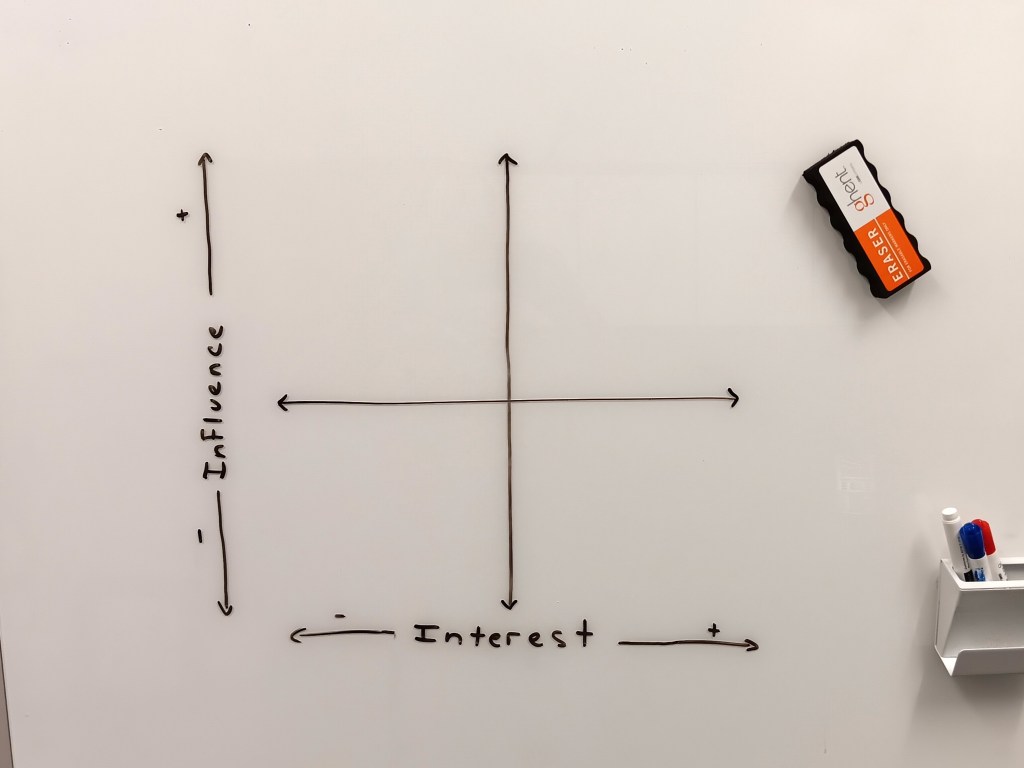
Interest is defined as other people’s hopes and expectations in us. Some stakeholders have more interest because of financial gain, social impact, conflicts, synergy, communication strategies, enthusiasm towards a project, attitudes, or a host of other reasons. For example, our shareholders have a lot of interest because their profits depend on us making money, but the city permit office has no interest in what we’re doing.
Influence is described as how much power a stakeholder has in our decision making. Those with high power can influence how we operate. Those with low power have little impact on the choices we make. Using the same examples, our shareholders don’t have a lot of influence on what we do. They just watch stock prices. The city permit office has a lot of influence on restrictions and limitations as we apply for various projects.
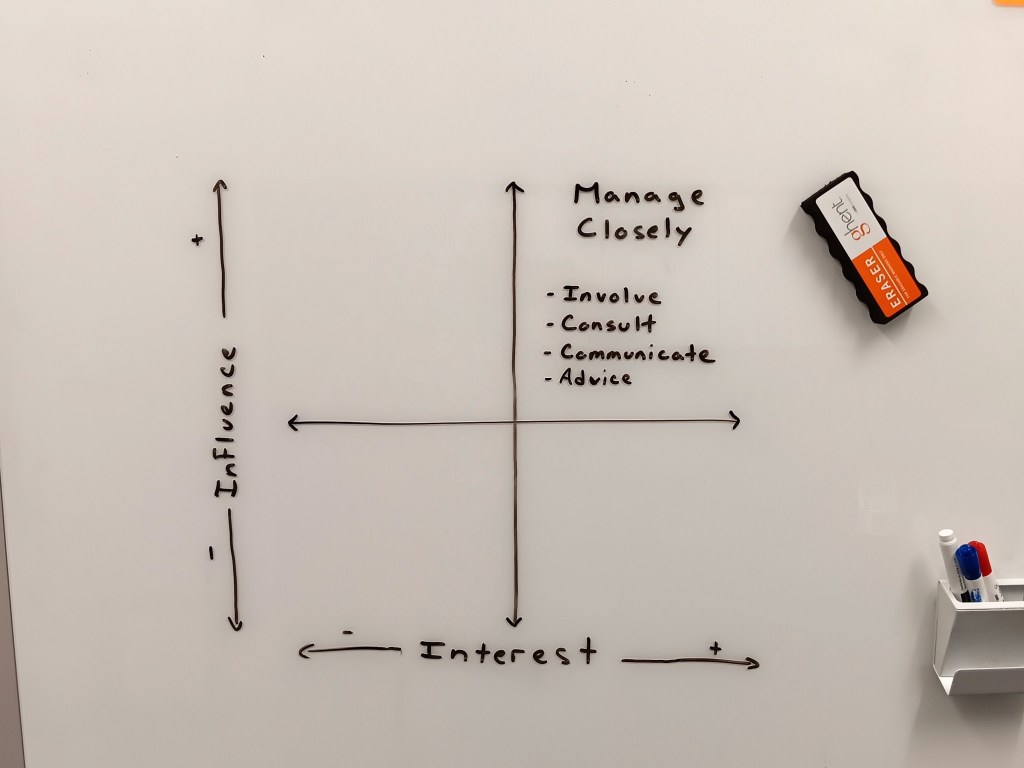
This divides our chart into four general categories:
Manage Closely (Top Right): High Interest-High Influence. This group is our focus. We involve them in activities, welcome them into decision-making, consult with them, and maintain open and clear lines of communication. Stakeholders in this group are the top priority. When they need something, we deliver! An example is our parent company. They care about our success and can influence our choices.
Keep Informed (Bottom Right): High Interest-Low Influence. This group is watching from the outside, and we need to keep them informed to build their confidence in us. We don’t need to manage them, but do need to communicate often. An example we’ve talked about is our shareholders. They want to make money from our company and will pull support if they don’t feel good about our business. These people are our consultants and can be ambassadors of our brand when managed right.

Keep Satisfied (Top Left): Low Interest-High Influence. This group is not usually watching what we do but can have a tremendous impact on our organization. We need to make sure they are comfortable with us without overwhelming them. We usually need stuff from this group, not the other way around. An example is the city permit office. They don’t care about us until we request building permits, and then they have all the power to approve or disapprove our requests. Keep them happy!

Monitor Activity (Bottom Left): Low Interest-Low Influence. The final group does not have much interest nor influence. With them, we still need to communicate, but can do it through email, newsletters, social media, or just whenever we see them. It’s always important to monitor their progress in case their positions change. An example is the business next door. They don’t care what we do and have no influence. But if we get too noisy or block the road with trucks, they may start to weigh in.

Now we can take our sticky notes with the stakeholders on them and plot them where they belong. Not every group has an equal stake in what we do. It’s important to chart them accordingly so we can prioritize the amount of effort we put towards them. Then, we should develop a plan for each stakeholder to map out a different strategy of engagement.

Simply put, the ones in the top right are our priority. They get the bulk of our energy. The rest we inform, satisfy, and monitor appropriately.
As a final point, our goal is to move everyone to the right and encourage them to have more interest in what we do. This creates allies, friends, partners, and advocates.
There’s a lot more detail on stakeholder analysis to include dividing them into groups such as change agents or blockers, analysis process steps to include matrix tables, the 10 different types of stakeholders, relations between cost, time, and quality, and countless ways to go deeper. Simply google this concept and you’ll be flooded with info.
But if we don’t have a basic stakeholder analysis today, we need to get one on the books so we know where to engage.
Mark took it all in. “It seems really simple and really complicated at the same time. But it looks like by gathering a few people in the building, we could easily prioritize where to put our efforts.”
Bryan nodded like a proud father. “Just make sure when you build your team to do this, they have interest and influence in the outcome.”
Leaders read, think, discuss, and write about leadership. Your first step should be to sign up for The Maximum Standard’s weekly email where you’ll get a leadership vignette delivered for free every Tuesday morning! This could also be your year to get published in the Maximum Standard—we’re always looking for authors.
 The Maximum Standard
I feel the most important external stakeholder and what many businesses would consider the single most important stakeholder overall, the customer was nowhere to be found. For most businesses, they directly influence the success of that business by impacting revenue and shaping the companies reputation.
LikeLike
Great point! I would also add that there are different types of customers that we need to focus on, each one requiring a slightly different flavor of messaging. Love the add on – thank you!
Steve
LikeLike
Great message. (Like always)
Uncle Carl
LikeLike