April 1, 2025
by Stephen T. Messenger
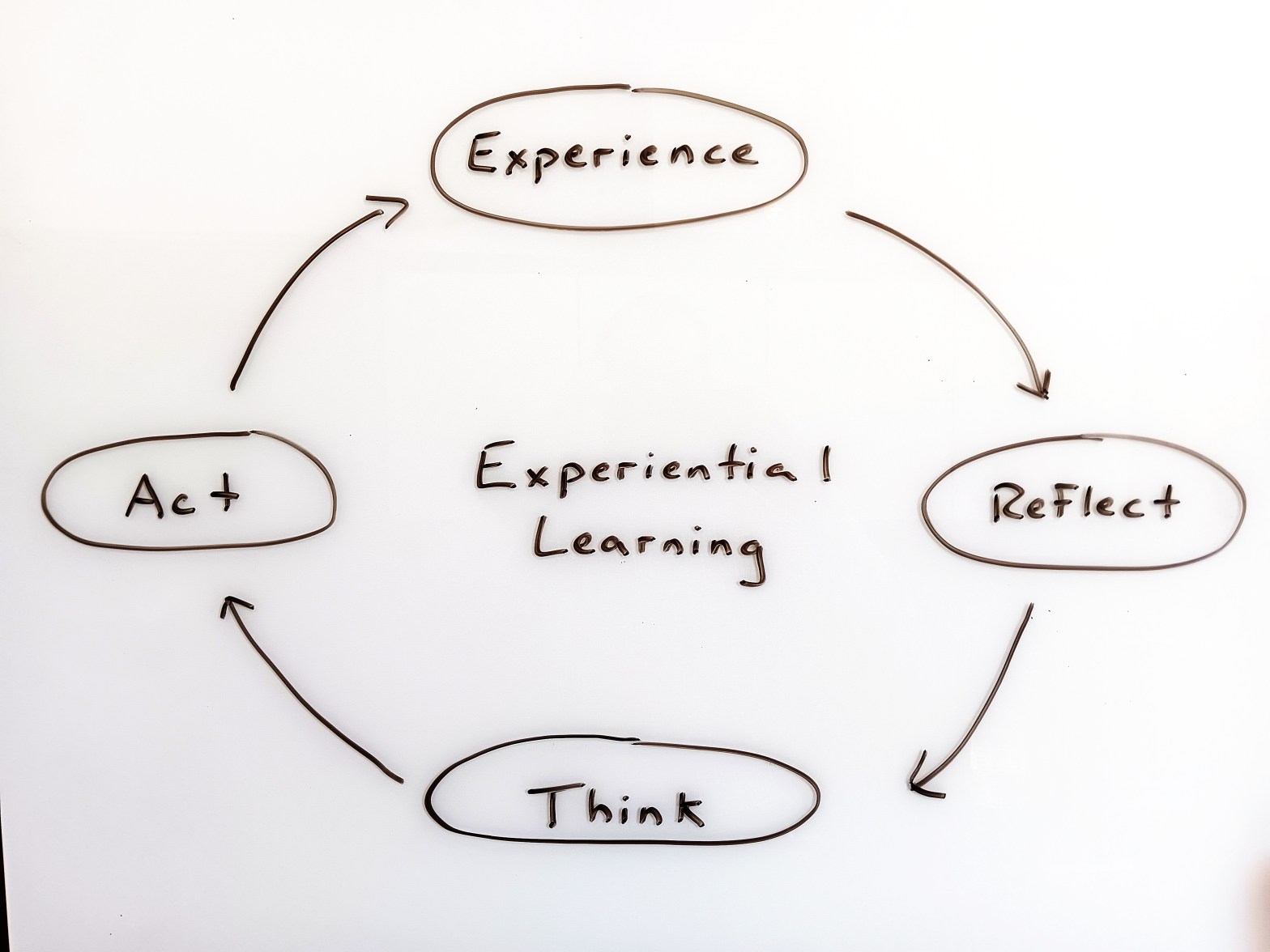
It’s one thing to read about something—it’s another thing to do it. How often do we study up on a topic but never actually experience it? In contrast, the concept of experiential learning uses studying and doing to develop increased understanding, knowledge, and skills. We learn best by performing an activity, reflecting on it, analyzing the results, and doing it again. This method can improve our skills in whatever area we choose.
In 2004, I fell in love with the Appalachian Trail. We moved briefly near a State Park with an entrance to the white blazes, and I took a few mile out-and-back hikes. Over the last twenty years, I’ve read books and articles, watched documentaries, visited museums, browsed YouTube videos, and talked to thru hikers to learn more. Finally, last week after two decades of dreams, I threw a pack on and took a 13-mile, one-way trip through the mountains. While my experiential learning was admittedly drawn out, I needed all four components to learn more about the trail.
The Origins of Experiential Learning
Kurt Lewin, German-American psychologist in the early 1900s, argued that learning is a four-stage cycle. It begins with a concrete experience, is improved by observations and reflections, grows through forming abstract concepts and new ideas, and is cemented by performing the activity again. The cycle is then repeated to improve knowledge and understanding.
This theory is grounded in having tangible experiences combined with individual and social learning to create opportunities for immense growth. Swiss psychologist Jean Piaget added to this with his idea that experience, conceptualization, reflection, and action are the basis for adult learning. The work of these men along with others led to the four stages of the Experiential Learning Cycle of experiencing, reflecting, thinking, and acting.
Experiencing. The first step is having a concrete experience. It’s the act of going out and trying something new. This could be a new sport, hobby, or interest. The key is to have “an experience” in a small dosage that helps us understand it more. A more conventional way of saying this is, “Just do it.”
When I began my interest in the Appalachian Trail, I went out and took a thirty-minute hike. It was short, fun, and exciting enough to encourage me to learn more. I walked without a pack, in great weather, and on a challenging uphill climb. I learned a lot while wanting more.
Reflecting. Once the concrete experience is complete, the second step is reflective observation where we think deeply about what we did and where we want to go next. This involves deliberate thought on our concrete experience, how we can improve, and what our next steps are. It derives new meaning from our feelings, thoughts, and actions.
After my short hike, I thought a lot about the trail. It was calling me. I dreamed about longer hikes and a 2,100-mile thru hike, equipment I would need, and ways to get back on the trail in both bulk and moderation. My reflection filled gaps from the concrete experience and helped me build on my journey.
Thinking. The third step is abstract conceptualization or thinking collaboratively about the event. This is where we bring in outside sources such as books, videos, experts, or other learners. In this, we share ideas and lessons which increase knowledge. The heart of adult learning is through interactions and conversations with others.
My thinking came in the form of books, websites, and videos along with chatting with the occasional long-distance hiker. It’s so important to add to our concrete experience and personal thoughts with outside ideas and conversations. It broadens our aperture and helps us see different viewpoints.
Acting. Finally, active experimentation brings our experience, knowledge, and collaborative conversations together to try it again. We test our new theories by repeating the activity with increased intensity. The cycle then repeats.
My hike last weekend brought together a significant amount of self-actualized and comprehensive ideas combined with many non-Appalachian Trail hikes over the years. This longer journey forced me to test hydration, nutrition, timing, and social theories on the trail. In the process, I began thinking about the next level of overnight stays, water purification, and unexpected weather precautions. The second experience answered questions and discovered new ones as the cycle repeated itself.
The Iterative Process
These four steps do not necessarily need to be conducted in order. Each repetition of doing, reflecting, conversing, and doing it again is an iterative process to increase knowledge at every step. In fact, many times they are done simultaneously and in different orders. The key is to experience things, reflect on that time, learn and grow individually and through others, and experience it again.
For example, if I wanted to write an article but had never done it before, I would probably start by reading how to write an article from experts. I would next think about topic, run it by some close colleagues to see what they think, and receive feedback. I would then reflect on that feedback and start writing while studying my topic. After a draft, I would talk to more mentors, study more writing techniques and my topic, and keep writing the article.
In this process, nothing was linear. I performed the task, reflected about my performance, spoke to others about it, and wrote some more. There was no order, but there was a continuous iterative process between these four tasks to generate improvement.
Go Walk the Trail
We learn best while doing. We can read or study a topic all day long, but until we’re actually performing the activity, we can’t experience the full benefits of learning. Experiential learning requires performing the activity, reflecting on it, talking with others about it, and doing it again. In the end, reading about a topic may be interesting, but until we physically do the activity, it’s an abstract concept.
My short trail jaunt combined with learning and discussing long distance hiking needed me to revisit the trail again to bring it all together. I now have a whole new lens on hiking plus a number of new questions I need to answer. The experiential cycle continues.
If there’s something we’re interested in, we need to “just do it!” You’ll be amazed by how much more we learn than reading alone.
Leaders read, think, discuss, and write about leadership. Your first step should be to sign up for The Maximum Standard’s weekly email where you’ll get a leadership vignette delivered for free every Tuesday morning! This could also be your year to get published in the Maximum Standard—we’re always looking for authors. We coach first time authors (and anyone) through the writing process if you need a little help. It’s worth taking the first step and showing interest.
This website is a personal blog and all writings, podcasts, opinions, and posts are the authors’ own and do not represent the views of the United States Army nor any other organization. Podcast music credit in this audio file is to: “Alex Productions – Legends” is under a Creative Commons license (CC BY 3.0). / @alexproductionsnocopyright
 The Maximum Standard
Love this. Our company has a quote on our wall that simply says “Experience trumps theory every time”. Just do it!
LikeLike
Jon, thanks for the quote and photo via other means. It’s so comfortable to ONLY think about things. James Huneker said, “He dares to be a fool, and that is the first step in the direction of wisdom.” Experience is usually gained through failure.
LikeLike