May 13, 2025
by Stephen T. Messenger
In 165 A.D., the Roman Empire was struck by a devastating pandemic (likely smallpox) known today as the Antonine Plague. It would kill as many as five million people over 15 years, including soldiers, farmers, and entire communities. At the helm of the empire during this catastrophe stood Marcus Aurelius, a philosopher-emperor trained in the Stoic tradition.
Rather than retreating into comfort or passing responsibility to others, Marcus stayed fully engaged. He led military campaigns on the empire’s borders while managing the health crisis at its core. He made difficult fiscal decisions, including the sale of imperial treasures to fund relief efforts and military defense. When Rome’s elite panicked or looked to scapegoat others, Marcus responded with measured calm and fairness.
Even as death surrounded him, Marcus continued writing his Meditations, quietly affirming his commitment to the Stoic virtues. These virtues include temperance in resisting despair, courage in facing fear and loss, justice in putting the good of the people above his own, and wisdom in seeking the right course.
His actions were not driven by ego or desire for legacy, but by principle. He governed as a servant of duty, not ambition. In a time when many would have succumbed to fear or indulgence, Marcus Aurelius modeled disciplined, values-based leadership. His life reminds us that great leaders are revealed in both comfort and crisis, and by the virtues they embody in both peace and chaos.
The Four Virtues
Cicero, Rome’s greatest orator and stoic philosopher, sought to find Summum Bonum, or “the highest good” in his personal life. Another stoic term is “eudaimonia,” meaning a life worth living, or a flourishing life. This goal, Cicero believed, is what we should all strive towards. Many people disagree on what eudaimonia is, but the stoics believe it’s virtue.
Every moment in life we have the chance to exercise virtue. Socrates, another precursor to ancient Stoicism, believed that by doing good repeatedly, we become good. It is in living virtuously that we become better. Even when faced with despair, sadness, elation, joy, or turmoil, we should control our reactions. By doing good in the face of challenges, we become better people.
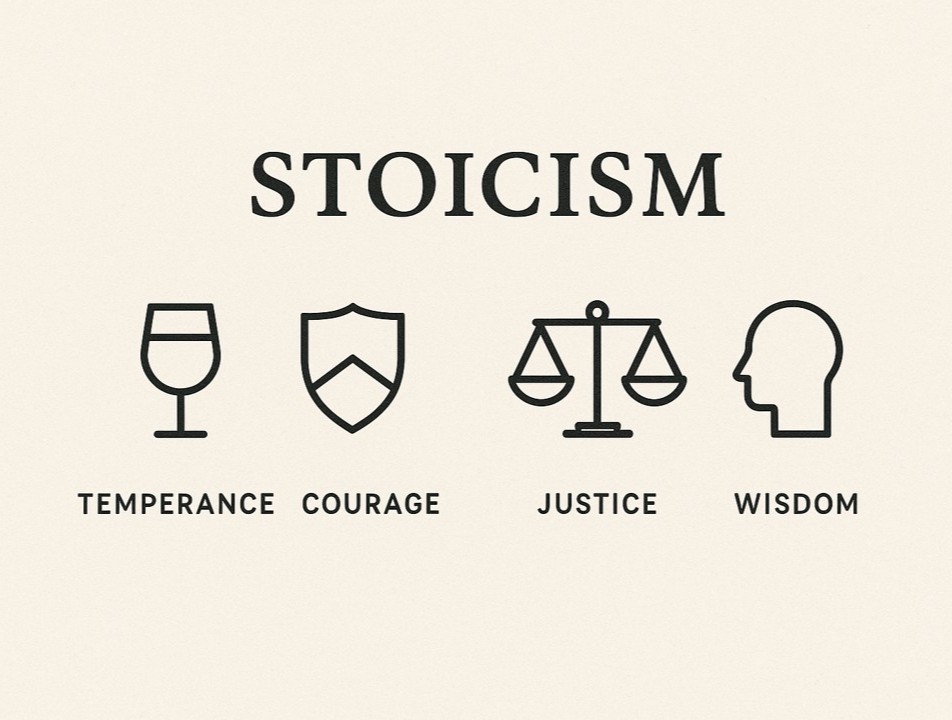
Stoicism rests on four virtues: wisdom, temperance, courage, and justice. According to Cisero, “Virtue is a habit of the mind, consistent with nature and moderation and reason.”
Temperance
This word has been mostly lost in the English language, but temperance closely resembles self-discipline and self-control. It’s the way we can manage our emotions when faced with challenging situations. This trait is commonly thought of when we’re being “stoic,” enduring hardships without reacting or showing emotion.
I talk about temperance as not letting the sine wave get too high or low. It is managing the extremes and controlling our attitude, rather than letting emotions dictate it. For Marcus Aurelius, it meant being unflappable even when Rome was ravished by plague.
Courage
The second virtue is courage, the ability to stand strong in the face of danger. This trait is not the absence of fear but the ability to press on in the face of it. This courage comes in many forms ranging from physical to mental to emotional. It could be providing an unpopular opinion, making a risky business decision, or walking out of a relationship.
For the Emperor, it was campaigning with his men during the peak of the plague or selling off portions of Rome to support his people. Courage is about perseverance and confidence that the actions we take will have positive effects.
Justice
Marcus Aurelius believed justice was the most important virtue and Ciscero agreed. In his work, On Moral Duties, he argued justice bonds human society together into community. It rests on principles that include: do no harm to others, treat possessions as either common or public, help those in need, and prioritize the good of society as much as oneself.
Marcus Aurelius illustrated this philosophy with this phrase: “What injures the hive injures the bee.” Justice is about thinking of others. Yes, stoics believe people should be held accountable for their actions, but the heart of justice is living in harmony with others.
Wisdom
For stoics, wisdom begins with the knowledge of what we can control and what we cannot. This characteristic helps us understand how to respond when we encounter both the positive and negative situations in life. Wisdom dictates our actions and helps us make decisions that will be helpful and beneficial.
Marcus Aurelius spent over a decade being mentored by his uncle, Antoninus Pius, the Emperor of Rome. Here, he studied everything he could to prepare himself for the throne. Near the end of Aurelius’ reign, a friend asked him where he was off to. He was headed to a lecture and told the man: “From Sextus the philosopher I shall learn what I do not yet know.”
The Interconnectedness of the Virtues
These four virtues help us think about how to achieve eudaimonia and live our best lives. They cannot act independently but must be used together. The virtues operate under three assumptions.
First, humans are concerned about themselves and will act accordingly. Second, we assume there are more people than just us out there and must interact with them. Finally, we understand there is a tension between the first two that will be exposed as we walk through life.
The first two virtues, temperance and courage, are an internal look to live a good life through patience and advancement. The third virtue of justice is an external understanding that we are part of a larger picture and must work in community. Finally, wisdom helps us deal with the highs and lows of life.
When we use them together, we are able to effectively act in a way that looks out for ourselves and our society, all while behaving in a way that produces our best life.
To Be the Best Version
Stoics believe that virtuous living will help us flourish in life. The four virtues of temperance, courage, justice, and wisdom are ways to help us interact with problems and people.
We get there by practicing these virtues and becoming better at them, one act at a time. Stoicism is about putting our personal ambition aside and leading appropriately every day through calm and chaos for the good of our teams. Whether leading Rome through a pandemic or in ordinary life, being virtuous is a great way to help us live well.
Click here to sign up for The Maximum Standard’s weekly email where you’ll get a leadership vignette delivered for free every Tuesday morning!
We’re always looking for authors. We coach first time authors (and anyone) through the writing process if you need a little help. It’s worth taking the first step and showing interest.
This website is a personal blog and all writings, podcasts, opinions, and posts are the authors’ own and do not represent the views of the United States Army nor any other organization. Podcast music credit in this audio file is to: “Alex Productions – Legends” is under a Creative Commons license (CC BY 3.0). / @alexproductionsnocopyright


Steve, this was a great lesson, the readings with the four stoic virtues provide a great opportunity for self reflection. I know there were several times where I saw where I was falling short or where I could apply the lessons. The other lesson is that it is very difficult to apply these lessons consistently over time, it requires work. But, I guess if it were easy everyone would do it.
Mike
LikeLike
Mike, appreciate the note. We all fall short of the four stoic virtues or miss the mark. But just being aware that we didn’t live up to our virtue system is a virtue in itself on reflection and seeking improvement. Sounds like a lot of wisdom you’re espousing!
LikeLike