by Stephen T. Messenger
May 12, 2026
We can all agree it feels terrible to fail. It makes us feel inferior, embarrassed, sad, and, well, like a disappointment. It’s something most of us try to avoid at all costs, yet falling short is the key that helps us improve little by little.
I’m currently teaching an elective on this topic. Over the course of five weeks, I challenged students to conduct exercises where they will not be successful. Each exercise is designed to try something, learn from it, and get better.
The exercise intensity ramps up every lesson. Week 1 is a private setback challenge. Week 2 is a public failure. Week 3 is to find the most important person they can on social media and have a conversation with them, anticipating multiple ghostings. Week 4 is an interview with another important person asking them about one of their personal misses. Finally, Week 5 is “dealer’s choice,” where they can choose to attempt a larger public challenge of their choosing.
On the first week, the task was to break a world record.
The House of Cards
The tallest house built out of playing cards was by Bryan Berg on October 16, 2007, when he built a tower of 25 feet and 9 inches tall at the State Fair of Texas.
This individual task was to spend about 40 minutes building a card house as tall as we could. After the time limit was up, we then had to research ideas on YouTube on how to build our tower taller. For the final 40-minute block, we then sought to build the tallest card house we could using the knowledge we learned from our research. In the online forum that week, we lamented our lack of skills with each other and shared lessons learned.
Now, my students are highly successful, top-of-their-career professionals who are not used to losing. They’re in the electives portion of a master’s degree program and have done very well over decades to get to this point. Yet here they were, expected to miss the mark.
This is a huge mindset shift. Last week in The Maximum Standard, we talked about how our biographies are full of flowery language and accomplishments, but underneath all those words are a litany of setbacks that have brought us success. The problem is, we rarely acknowledge our shortcomings and certainly don’t actively practice them. Why? Because it’s frustrating! And what kind of teacher would I be if I didn’t take a swing myself?
Not All Failures Are Created Equally
Before we get to card stacking, we first must acknowledge that not all failures are created equally. Amy Edmondson, in her 2011 HBR article, “Strategies for Learning from Failure,” outlines a spectrum ranging from praiseworthy to blameworthy. It’s fun to talk about and try failing, but there are times and places to falter, and times and places to succeed.
For example, exploratory testing is where we seek to expand our knowledge base by trying and experimenting. This is a good use of the process. Much like building a card house, it’s experimentation. We go into an event expecting to struggle and learn from it.
On the other end of the spectrum is inattention or deviance. Edmondson calls this blameworthy. When someone chooses to knowingly err by neglecting their duties, there’s very little learning that comes from negligence. Those are the types of activities that we must police and correct.
In the center of the scale are items such as task challenge and uncertainty. Task challenge is something that’s difficult and won’t be completed successfully every time. Think of a complicated event with lots of moving parts. Even with competent leaders and proper preparation, friction, coordination gaps, or timing errors can cause the plan to fall apart. The outcome isn’t due to negligence, but the inherent difficulty of synchronizing complex operations.
Uncertainty is when we face an unknown situation and take reasonable steps to solve the problem with unsuccessful outcomes. An example of this is when information is incomplete, and conditions on the ground are unclear. Leaders make informed decisions based on limited data, but outcomes may still fall short because key variables were unknowable at the time.
Some shortcomings are bad, some are good, and some are unavoidable. We should know when it’s not okay to miss, when it’s encouraged, and when we allow mistakes to occur in response to the situation. Building a card house is exploratory testing, where we’re in learning mode, and in this case, learning to lose on purpose.
When It All Crumbles Down
That brings us to building my card house higher than the world record of almost 26 feet. This task had nothing to do with how high we get the cards, but two other points: our ability to try something new and learn from it, along with our accepting defeat as inevitable at times.
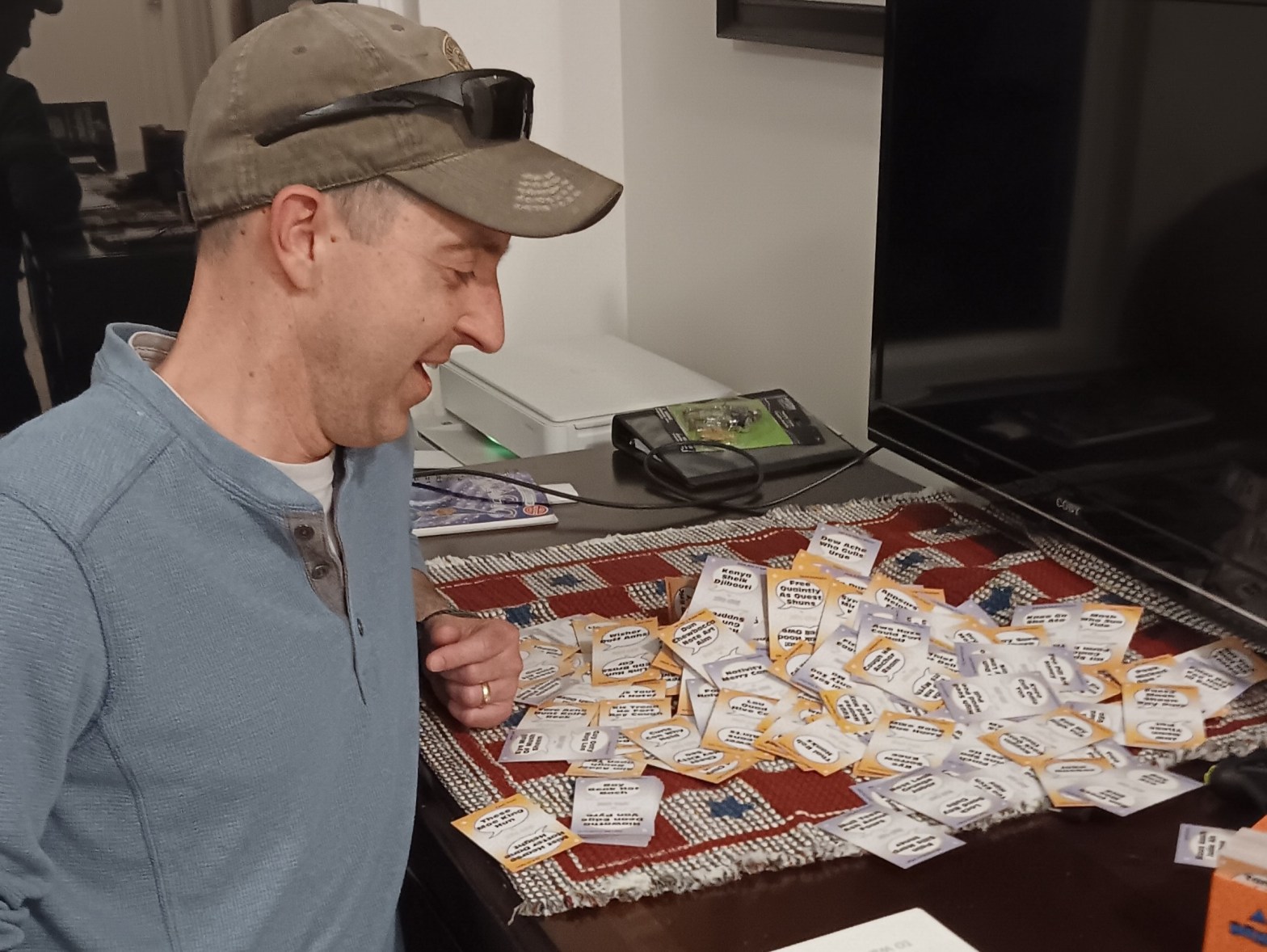
I personally struggled. My card house was a whopping three levels tall, which I believe was one story short of my all-time life record. I tried and restarted multiple times in the 40-minute window, each time holding my breath on every card. There was a distinct “thump” of cards every time my tower cascaded down. I’ll admit, it was frustrating.
For the second 40-minute block, I scoured the internet for advice, and did I ever find some! I found three fundamental flaws. They were having a low-friction surface, a poor foundation, and not enough roof cards. Once I restarted construction on a mat, shored up the foundation using multiple T-shaped supports, and reinforced each ceiling, I gained a few stories in the next attempt!
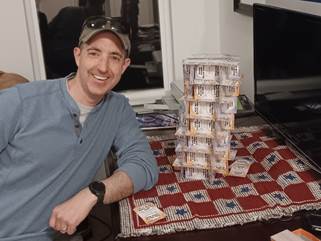
For the final 40 minutes, I was having fun and setting personal records. I was up to eight stories at one point! Other advice from the internet was using cards with squared edges and then using 5×8-inch cards instead of standard playing cards. Sure, neither would qualify for the world record, but suddenly I found myself experimenting and thinking differently to break personal height barriers.
My exploratory testing helped me do two things. First, I grew exponentially in this task in just two hours by trying, failing, researching, learning, trying again, and repeating. It was amazing how much progress I made in a short amount of time by expecting not to succeed and being open to new ways.
Second, I became much more comfortable with failure. Going in with a mindset that the results will be terrible and I’m expected to be bad was freeing. Instead of being frustrated in my exploration, I was more than happy to pick up the pieces when the tower fell. Bryan Berg’s record is safe for now, but my eight-story tower felt like a skyscraper compared to where I started.
That whole week, I became even more comfortable with trying new things and messing up. My mindset went from caring what other people think to bragging about my struggles. And in every process, I learned a whole lot more.
Fail to Succeed
Too often, we see failure as bad. A better way to think about it is as if we’re operating in the learning zone. Whenever we’re struggling between a failed task and success, we’re typically frustrated, and that’s good! It means we’re learning.
The more we can identify safe spaces to be unsuccessful and focus on improvement, the more progress we’ll see. Too many people sit in stagnant zones or the status quo and are comfortable with limited growth. But when we embrace positive setbacks while focusing on improvement for the next iteration, we can leverage them for growth over frustration.
No one wants to fail. But we all want to grow. Leveraging these types of exercises leads to success when done right. Try it in the comfort of your own home. And see what happens when you don’t succeed.
Click here to sign up for The Maximum Standard’s weekly email where you’ll get a leadership vignette delivered for free every Tuesday morning!
We’re always looking for authors. We coach first time authors (and anyone) through the writing process if you need a little help. It’s worth taking the first step to get published.
This website is a personal blog and all writings, podcasts, opinions, and posts are the authors’ own and do not represent the views of the United States Army nor any other organization. Podcast music credit in this audio file is to: “Alex Productions – Legends” is under a Creative Commons license (CC BY 3.0). / @alexproductionsnocopyright

