June 30, 2026
by Patrick Mulloy
The Joint Special Operations Command (JSOC) represents the standard for special operations, executing missions with precision that few organizations can replicate.
But it did not begin that way.
In 1980, U.S. special forces attempted to rescue 53 American hostages held by Iran. It ended in catastrophe. Eight servicemen were killed, multiple aircraft were lost, and plans unraveled under real-world conditions.
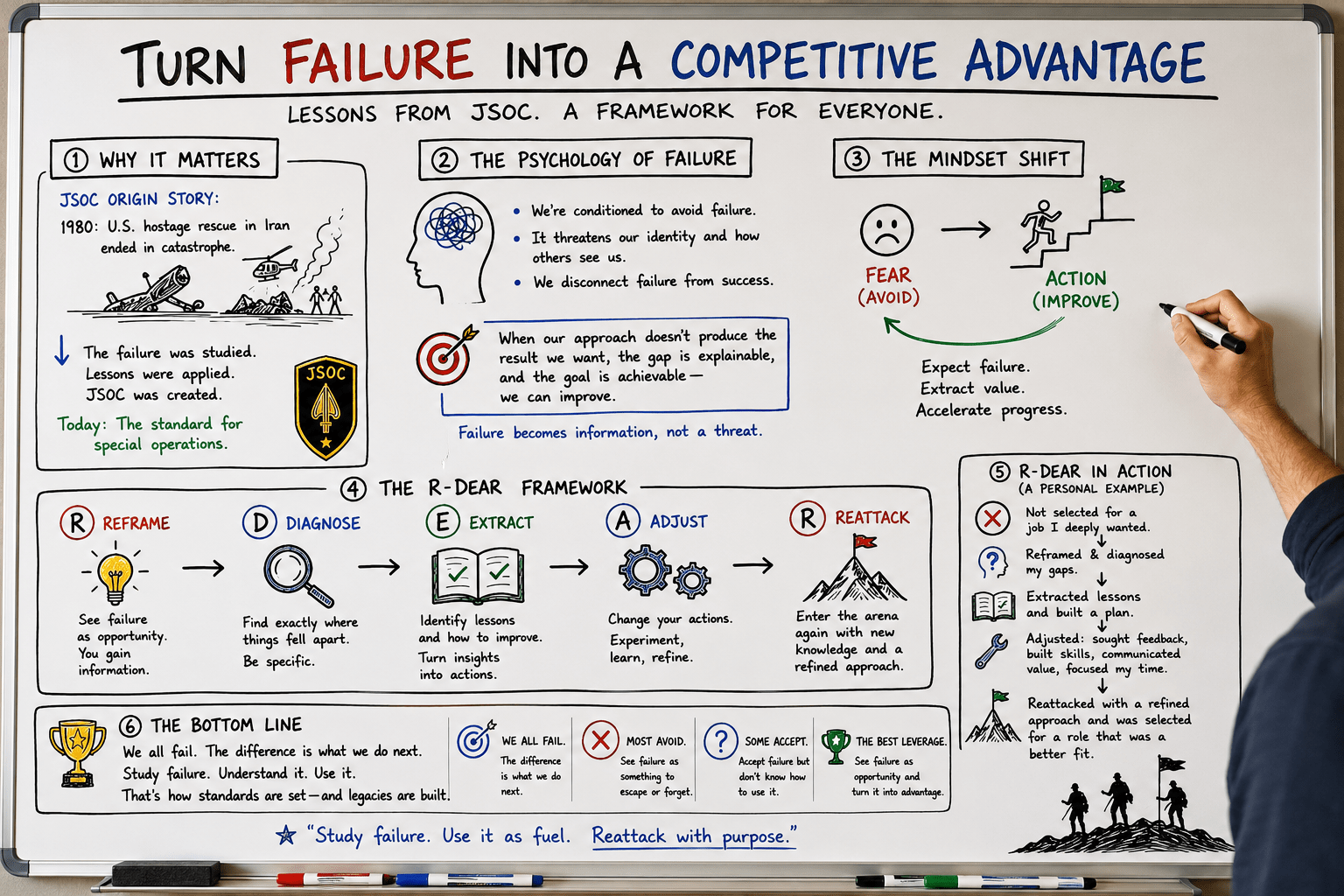
Although the operation failed spectacularly, a special commission was formed to reframe how they operated, and the lessons led to the establishment of JSOC and its unmatched military excellence. Like JSOC experience, sustained success is built on failure that is studied, understood, and used as a competitive advantage.
The best organizations understand the psychology of failure, recognize how distorted standards impact our learning, and have a framework to turn setbacks into comebacks.
The Psychology of Failure
From a young age, we are conditioned to avoid failure. We are taught to associate failure with punishment and shame. We do this because failure feels dangerous to our identity and our sense of control.
Don’t fail the test, don’t lose the game, and don’t fall behind. We live in a merit-based world built on grades, GPAs, rankings, evaluations, and resumes. Excellence is rewarded while failure is forgotten. When we fail, our instinct is to quit, forget, and move on.
Failure also challenges our perception of how others see us and how we see ourselves. We fear disappointing people who rely on us, and we fear the unknown that failure brings. Because of this unhealthy relationship with failure, we rarely link success with failure and even more rarely understand how to use failure to our advantage.
But the people who succeed understand that failure is a part of everyone’s journey and is not to be feared. They are taught how to interpret, process, and use it properly through a codified framework. When we are mentally prepared to expect failure and extract value from it, failure becomes information, not a threat to identity. And when that happens, progress and opportunity accelerate.
When our current approach does not produce the outcome we’re aiming for, the gap is explainable, and the goal is achievable, we can improve.
Moving from a state of fear to one of action requires a systematic approach. A simple five-step framework gets us there.
Turning Failure to Opportunity: The R-DEAR Framework
Failure invites unpleasant emotions like shame and disappointment. But it also forces us to confront our limitations and understand that we were not as capable as we believed.
By following a five-step process (the R-DEAR Framework), we can turn failure into progress and ultimately success.
Reframe → Diagnose → Extract → Adjust → Reattack
Reframe. First, we must reframe our old way of thinking and see failure as opportunity.
We need to separate our emotions from the event. We need to recognize that the moment we fail is also the moment we gain information. Before the failure, we were operating on assumptions. After the failure, we’re operating on data.
That shift is foundational. Without it, the other steps won’t work. We’ll be too busy protecting our ego to learn anything.
Diagnose. This step is about pinpointing exactly where things fell apart. The more specific our diagnosis, the more actionable our next step. “I failed” teaches us nothing. “I underestimated how long this would take” gives us something actionable.
Extract. This is the internal mental realization regarding “how” we can improve. Based on what broke down, we can assess the actions that require change. Identify the lessons learned clearly and specifically so we know exactly what to work on.
Adjust. Now that we have studied “what” went wrong and determined “how” our actions will help us change, it’s time to adjust our external actions through actual execution. Treat this step like a lab session, probing and experimenting until we find a better outcome.
Reattack. Reattacking is entering the arena with new information and a refined approach to test whether our adjustments were sufficient. This can be intimidating. It requires vulnerability because it exposes us to the possibility of failing again. It requires that we trust our preparation and choose the path of long-term success over short-term comfort.
Every meaningful improvement in performance is built on the R-DEAR Framework. Now, let’s see it in action.
R-DEAR Framework in Action
Several years ago, I was told “No” for a position I deeply wanted. I had the experience, the evaluations, and the right connections. When the decision was announced, and my name was not on the list, the disappointment was immediate and devastating.
My first instinct was defensive. I blamed external factors and questioned the criteria and fairness. But after the initial emotion settled, I had to make a choice. I could treat the outcome as a judgment on my worth, or I could reframe this failure as an opportunity and treat it as information to improve.
I started to diagnose honestly. Where had I assumed I was competitive rather than verifying it? Where had I relied on past success instead of demonstrating current relevance? Where had I underestimated what the role truly required? What I found were skills I believed were my strengths, but I lacked experience at the next level.
From there, I began to extract lessons. I admitted that strong performance at my level did not equate to potential at the next. Instead of dwelling on the rejection, I built a deliberate plan to close the gaps I had identified.
I then had to adjust how I prepared. I sought direct feedback rather than informal reassurance. I sharpened the skills most relevant to the roles I aspired to hold. I became more intentional about how I communicated my value and more disciplined about where I invested my time. The focus shifted from wanting the title to becoming undeniably qualified for it.
Then came the reattack. I pursued the next opportunity with a more refined approach and a deeper understanding of what excellence required. The outcome was different. All the effort resulted in being selected for a role that aligned with my newly created skillset and mentality. That role was being board selected for Professor of Military Science at the University of Central Florida, one of the top five largest universities in the country by population and one of the best Army ROTC programs in the southeast. It was a job I thoroughly enjoyed, found immensely rewarding, and one that I would never have experienced without first overcoming failure.
Looking back, not getting that job accelerated my growth more than getting it would have. The rejection forced honesty, which forced improvement. And the improvement created capacity I did not previously have.
That is what failure does when we allow it to work for us.
Failure Is the Competitive Advantage
Success is the result of accepting failure and using it as a competitive advantage. The disaster in the Iranian desert exposed structural gaps that were studied and corrected, which ultimately created the standard for joint special operations. Their diagnosis of issues led to the creation of a unified special operations command, forming one of the most effective fighting forces in the world today. In the same way, professional setbacks don’t define our ceiling; they reveal the path to reach our full potential.
We all fail. Most people don’t see a connection between failure and success. Some people accept the eventuality of failure but are unsure how to extract value from it. Others, the most successful people, view failure as an opportunity. Which one are you?
Patrick Mulloy is a recently retired active-duty Military Intelligence officer and Professor of Military Science at the University of Central Florida. He holds a Master of Arts from the University of Arizona and the School of Advanced Military Studies and is currently a Doctor of Education candidate at the University of North Carolina at Chapel Hill.
Connect with him at LinkedIn: https://www.linkedin.com/in/patrick-c-mulloy/
Click here to sign up for The Maximum Standard’s weekly email where you’ll get a leadership vignette delivered for free every Tuesday morning!
We’re always looking for authors. We coach first time authors (and anyone) through the writing process if you need a little help. It’s worth taking the first step to get published.
This website is a personal blog and all writings, podcasts, opinions, and posts are the authors’ own and do not represent the views of the United States Army nor any other organization.

