by Stephen T. Messenger
August 25, 2026
“If you don’t want people to have Mickey Mouse attitudes, then don’t give them Mickey Mouse work.”
Frederick Herzberg
One out of every three workers is unhappy with their job. The good news is that job satisfaction has been growing since 2008, when 58% of people were dissatisfied with their position. The bad news is that up to one-third of our people could be looking for a new job.
Isn’t it interesting how some groups in a workplace have high morale, while others doing a similar job have low morale? Logic says morale across both should be the same.
I was visiting different workspaces in my organization at a previous assignment, just going around saying hi to people. These sections did relatively the same work, but were in different buildings with different bosses. It became very obvious that some groups were excited to be there, and other groups hated their jobs. It wasn’t because of the environment; they did exactly the same thing. It was the meaning they took from their work.
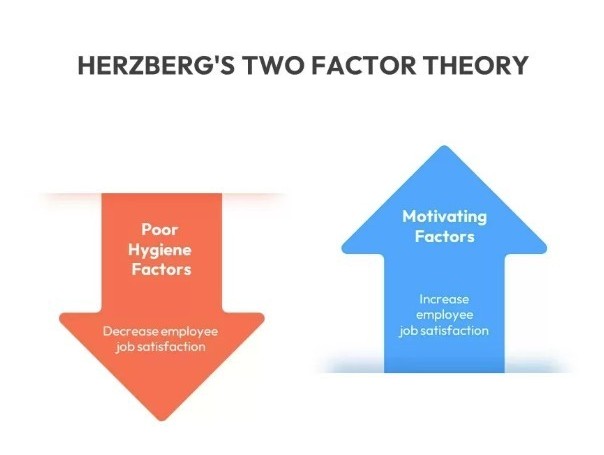
Frederick Herzberg developed this idea with his Two-Factor Theory. He concluded that it’s not the items we find on a job description like pay, location, and conditions that make us love our job. It’s the motivators, such as recognition, responsibility, and achievement.
If we’re to encourage others around us to enjoy their work, it’s not contingent on the environment, but on the work itself and how we treat our team.
Two-Factor Theory
In the 1960s, Herzberg interviewed accountants and engineers to determine what satisfied and dissatisfied them in their workplace. He then listed the results in two categories: motivators and hygiene factors.
Motivators are intrinsic needs that people say bring them job satisfaction. These are items such as achievement, recognition, responsibility, and advancement. They allow people to grow and become better versions of themselves. I saw this in the first section where independent workers were getting after their jobs with high autonomy and maximum responsibility. The second section, where morale was low, had a micromanaging boss who provided few opportunities.
Hygiene factors are extrinsic needs that can lead to dissatisfaction at work. These cover things like pay, policies, working conditions, and coworkers. All these hygiene factors are present in any workplace, and any negative perception of them creates dissatisfaction.
Interestingly, if a boss works only on increasing hygiene factors, Herzberg found job satisfaction will not increase. Increasing pay or making better policies doesn’t help people like their job more. Neither will better office furniture or a ping-pong table in the break room make a job magically better.
The danger in hygiene factors is that if the conditions are so poor that employees are distracted, their satisfaction will drop. The key is to keep these factors at, or preferably above, an acceptable level for people to do their jobs.
If we maximize the motivators, we can quickly increase the satisfaction of employees, which in turn causes them to perform better. The key is to provide meaningful work that matters, recognize people, and delegate responsibility and autonomy to others so they thrive. In doing so, we present opportunities to grow and promote from within the organization.
This study basically concludes that leaders who provide their people meaningful work and recognize them for it will have happier employees than those who simply hand out t-shirts with company logos, pay raises, and generous telework policies.
Enhancing Employee Experience
Now that we know why people are motivated at work, we have to implement these principles across both the hygiene and motivation factors. First, we have to know what specific factors employees are concerned about. The easiest way to find out is through a survey.
Gallup offers the Q12: The World’s Leading Employee Engagement Survey. It’s 12 questions that cover basic needs, individual contributions, teamwork, and growth. They ask questions to pinpoint where we need to make changes. For example, Question 4 asks if the employee received praise in the last seven days. Once we understand where problems may be, we can then fix them.
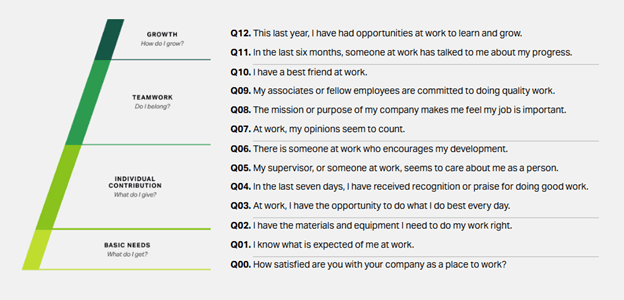
First, we address the hygiene factors to ensure the extrinsic needs of employees are met. If they have adequate pay, working conditions, security, and helpful policies, they should be satisfied in their jobs. If not, we fix those.
Second, we look across the motivation factors to see where we may be struggling and how to improve. The five major motivators from the Two-Factor Theory results are:
1. Achievement. People show up to work every day wanting to do a good job. It’s up to the boss to assign projects and positions that put them in a place to excel.
2. Recognition. Everyone wants to get an “Attaboy” from their boss. If we’re not thanking our people and rewarding them, we’re not helping them feel valued.
3. The Work Itself. This is a hard one because many jobs consist of repetitive tasks and the boss can’t change them. However, the best leaders can communicate that purpose effectively such as connecting a routine data-entry task to generating helpful analysis.
4. Responsibility. Being in charge of our own world is important. The more we can delegate authority, the more satisfaction occurs at the individual level.
5. Advancement and Growth. Perhaps we can’t offer promotions, but we can always offer growth. People want to improve. Give them chances to up their game in education, knowledge, and experience.
Finally, don’t underestimate the power of a tough mission. While not on the top five list, issuing a challenge to employees is important. Most people like to conquer a challenge. In what may be an apocryphal story, famed explorer Ernest Shackleton reportedly put out an ad to attract courageous adventurers for his dangerous expedition to Antarctica. It read:
“Men wanted for hazardous journey. Low wages, bitter cold, long hours of complete darkness. Safe return doubtful. Honour and recognition in event of success.” As the story goes, over 5,000 men and “three sporty girls,” answered the call.
We were all built to accomplish things. Make it a challenge.
We Control People’s Satisfaction… Kinda
There are going to be people out there who won’t like their job no matter what. They’ll have poor attitudes and hate any work they get. But the majority of people are looking to come into work and do something they can be proud of when they go home.
The leader controls a good amount of worker satisfaction through these two factors. The first is making sure working conditions meet the hygiene standards required to get the job done. The second is providing motivating factors that bring fulfillment to workers through achievement, recognition, good work, responsibility, and advancement.
When I walked through those different sections, it was clear which bosses were providing an atmosphere of challenge and autonomy. It was clear which were simply getting the job done without thought for employee satisfaction. This is a key and simple perspective that we should all keep in the front of our minds as we lead organizations to both complete the mission and foster satisfied employees.
Click here to sign up for The Maximum Standard’s weekly email where you’ll get a leadership vignette delivered for free every Tuesday morning!
We’re always looking for authors. We coach first time authors (and anyone) through the writing process if you need a little help. It’s worth taking the first step to get published.
This website is a personal blog and all writings, podcasts, opinions, and posts are the authors’ own and do not represent the views of the United States Army nor any other organization. Podcast music credit in this audio file is to: “Alex Productions – Legends” is under a Creative Commons license (CC BY 3.0). / @alexproductionsnocopyright

