by Stephen T. Messenger
June 9, 2026
We all want to be resilient. It’s a shame that life has a way of testing that concept. Just when we survive a winter, the next one comes rolling in. But as a leader, it’s critical that we endure the problems of life and set the example for everyone around us that we can lead through adversity.
This happens to all of us at times. I’m currently working on a large writing project. I took a number of steps forward in the past year, but I’ve just taken one big step back. An editor came back with a large number of edits, which drained my desire to continue the effort. It can be overwhelming to see a large chunk of the progress we gained lost. When my writing project came back with those major edits, I entered a proverbial valley. I felt defeated, frustrated, and tired.
Setbacks can challenge even the most mentally hardened of us. When we experience an unexpected situation, our brains see this as a gap between what is and what we think should be. This triggers a dopamine drop. Without this chemical, we lose our motivation levels and experience an emotional winter. An emotional winter is when our brain loses its normal rhythm. Our drive and motivation levels are reduced, and everything feels insurmountable. This can make it hard to think, act, or find the will to get back in the game.
But the good news is there’s a way out. Dr. Tracey Marks, a leading voice in mental health and neuroscience, says that three brain-based strategies can help. First, take action. Second, establish micro-goals to start tackling the project one step at a time. Third, find sustainable dopamine habits that bring progress. When we’re feeling like the winter will never end, these three steps can get us out of our funk quickly. One person who used these concepts without knowing the framework was our first President.
Valley Forge
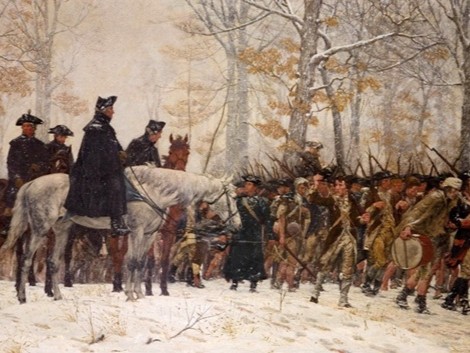
General George Washington felt the cold chill of defeat in December of 1777 and found himself at the beginning of a long winter. Things were looking up 12 months ago after a daring raid across the Delaware River, but since then, the British had proved their mettle. In 1777, the British seized the capital of Philadelphia, forcing the American forces to retreat to Valley Forge.
Attempting to stop the British from taking Philadelphia, Washington had marched to meet them, only to be repulsed at Brandywine and Germantown. While fighting bravely, the Continental Army struggled with large-scale maneuvers and orderly retreats. They failed to protect the capital and fell back to Valley Forge for the winter, licking their wounds.
In the harshest of conditions, Washington had to confront the brutal reality that he was losing, and needed to change his strategy to be successful. More than 12,000 soldiers and 400 women and children marched into the camp. Food was scarce, and the temperature was cold. It would have been easy to fall into a dopamine deficit and an emotional winter.
But over the course of the winter, Washington didn’t just survive; he thrived. He reenergized his army by improving it physically, mentally, and technically to come out of the cold season stronger and ready to confront his adversaries. Thankfully, Washington seemed to understand intuitively the types of activities that can lift people out of their negative mindsets. His actions reflected Dr. Marks’ three neuroscience steps.
Take Action. Upon arrival, Washington immediately ordered the construction of two miles of breastworks and fortifications to establish a defensive posture. This first step was able to focus the troops on being immediately productive and ready to face the various trials throughout the winter. The Chinese proverb that a journey of a thousand miles begins with a single step is very true. When we feel overwhelmed, often the best thing we can do is take some sort of action to spur progress. This triggers our brain that the next step is possible as well.
Establish Micro-goals. Next, Washington established priorities of work to ensure that everyone was productive and making positive efforts after their defeat in Philadelphia. In this case, he ordered the construction of 1,500 log cabins, improved camp conditions and sanitation, built a bridge over the Schuylkill River to establish supply lines, and set up commissary operations, among others. These short-term goals kept the troops active, fed, healthy, and making progress. By making positive gains, our brains get wired to want to tackle the next goal in life. Every win is a foundation for the next one.
Develop Sustainable Activities. Washington next focused on training the army for battle. He invited a Prussian officer, Baron von Steuben, into the camp to train his men. Steuben focused on European-style drills and company operations. He taught musket reloading, bayonet charges, column marching, and officer leadership. These drills were the foundation for future success in battle, and the daily routines of training were the long-term dopamine hit the soldiers needed to succeed. Steuben’s instruction provided the enduring actions the army needed to remember that long-term success was possible.
When it looks like we’re about to enter that long winter, we have to quickly get our heads in the game. After all, everyone is watching us to lead. If we’re losing our motivation, so will they.
Entering a New Season
Just like Washington’s troops, I had to shake off the loss. My first step of planning how to make my edits got me back in the game. I started looking at each section, one at a time, and made significant progress on the first few. Now that I have the initial step behind me, micro-goals to attack, and a sustainable way to make progress, I’m once again engaged.
It’s easy to get frustrated. Whether we are being driven out of the capital or working on a simple project, life can seem overwhelming and cause us to spiral. But by taking that first step and establishing a plan of attack, we can find that enduring process to finish our goals. George Washington knew that defeat was not the end. Often it requires enduring the long winter through sustainable plans to enter a new season of success.
Click here to sign up for The Maximum Standard’s weekly email where you’ll get a leadership vignette delivered for free every Tuesday morning!
We’re always looking for authors. We coach first time authors (and anyone) through the writing process if you need a little help. It’s worth taking the first step to get published.
This website is a personal blog and all writings, podcasts, opinions, and posts are the authors’ own and do not represent the views of the United States Army nor any other organization. Podcast music credit in this audio file is to: “Alex Productions – Legends” is under a Creative Commons license (CC BY 3.0). / @alexproductionsnocopyright

