September 8, 2026
by Stephen T. Messenger
My boss was wrong, and everyone knew it but him. It was a key decision that would have an impact for years, yet he didn’t see it. The only question was: Who could convince him, and when should they try?
It reminded me of the classic fable of the Emperor’s New Clothes. Tricked by con artists into wearing invisible garments seen only by intelligent people, the emperor and his entire court pretended in public that they could see them rather than admit they couldn’t. It took a child shouting out the truth for the townsfolk to agree the clothes were a farce, yet the awkward king marched on anyway, refusing to admit his mistake.
When our boss is making a bad decision, it’s up to us to protect them. We can influence some people, but others we can’t. Regardless, it’s important to try before everyone realizes the boss is wearing no clothes.
Step 1: Make Sure Our Advice Is Sound
The first step is probably the hardest. If we’re going to offer a recommendation that the boss is wrong, we’d better be right. These are usually hard decisions with no true right or wrong answer until time passes. So, before we tell the boss they’re wrong, we’d better reflect on whether our advice is sound counsel.
This involves understanding the issue, thinking through the problem, developing solid recommendations, consulting with others to test our ideas, and generally knowing what we’re talking about. If we go through these steps and still feel we’re right, it’s time to confront the boss. There are four general times and locations to do this, and it behooves us to know them.
When and Where to Confront the Boss
I can’t for the life of me remember where I saw this. The credit is not mine—it came from a senior U.S. Army leader speaking one day. If anyone has heard it, I’d love to know the source.
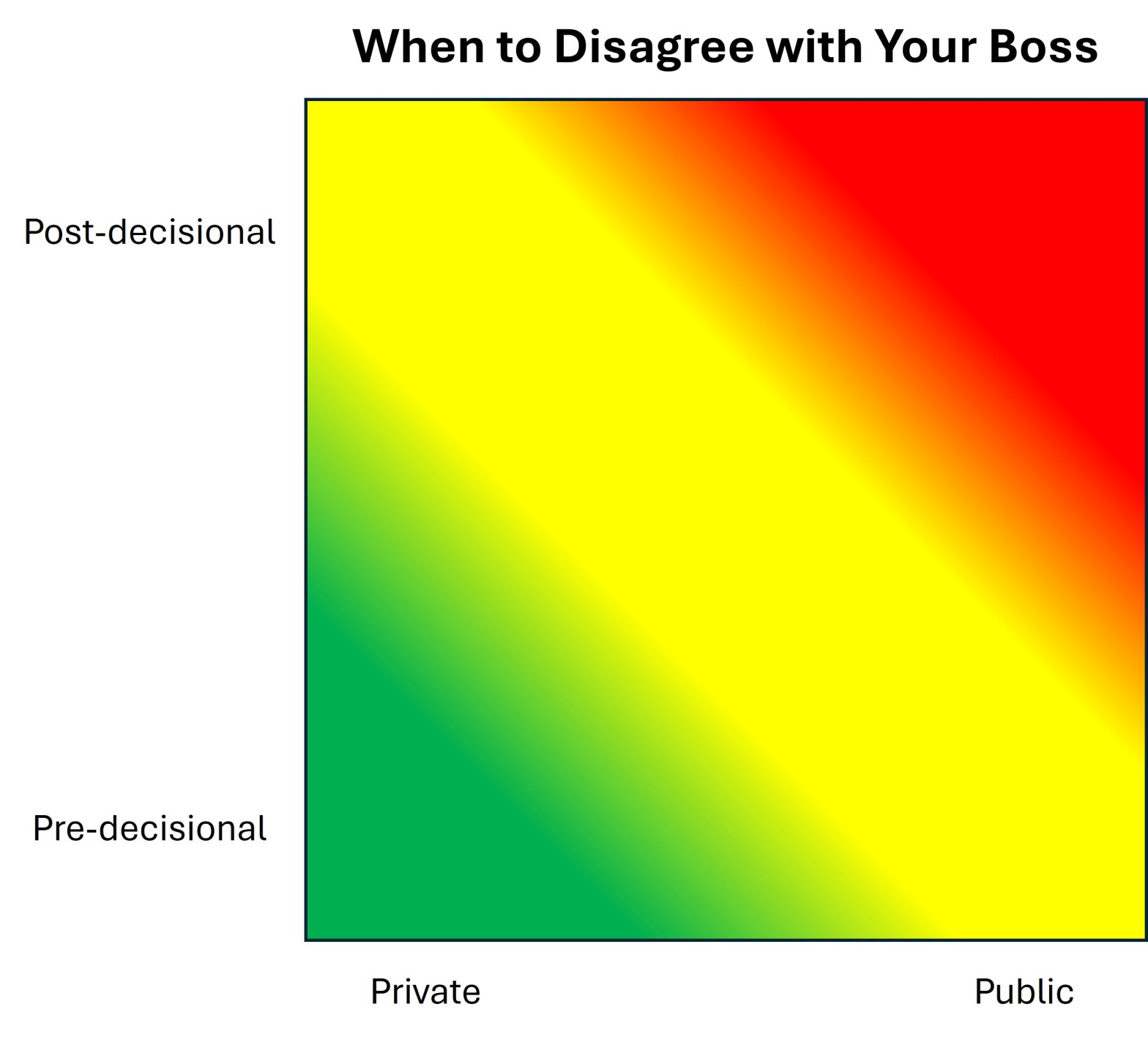
There are four general categories of disagreeing with the boss, graphed on two axes. We can bring an issue up in public or private, and we can address it either pre-decisional or post-decisional. Regardless of the timing, this graph assumes the boss has made or is leaning toward a decision we think is wrong. We’re far beyond brainstorming.
A final note before we get into it: there are many gradients to these settings, so it’s not a clean graph. Generally, though, we need to understand how we confront our boss.
Pre-decisional and Private (Go for it!)
Great news! The boss hasn’t made the decision yet, and we have them behind closed doors. This is the optimal time to let our opinions be known and convince them there is a better way. Hopefully, we have done our homework, have a great pitch to change their mind, and can put on our lawyer hat to sway the judge to our recommendation.
This is predicated on having a great relationship with the boss. It takes time to build a rapport and a track record of success in their eyes. Once we establish credibility, we have more sway to help decisions fall in a better way. When we have that one-on-one, we can carefully lay out our argument leading to a better decision.
I have had much success with this, where talking through the problem alone with a boss who respects us produces favorable outcomes. It won’t always work, but it has the highest chance of success.
Pre-decisional and Public (Caution)
Here’s where it gets fun! When the boss is already leaning toward a bad decision, but the topic comes up in a public setting, we have a great opportunity, but we have to exercise extreme caution. This takes tact, because there are many personalities in the room who could blow it up at any time. We don’t want the boss to feel ganged up on.
First, we have to build a coalition going into the meeting where everyone knows their speaking roles. Who will the boss listen to? Who is the subject matter expert? Who should never open their mouth in public? Once we identify roles, we can assign each person a topic to speak on and wargame the conversation, hopefully pulling the argument our way.
This is challenging because of all the people in the room. I’ve seen this work well when highly rehearsed, and I’ve seen a boss harden their position when they felt threatened. Make sure this engagement is highly rehearsed and that we know who is going to say what in the room, even if they don’t agree with us.
Post-decisional and Private (Caution)
Bad news. The boss has already made a decision, but we think we can talk them out of it. This is difficult even in a private setting. It requires the same setup as pre-decisional and private (knowledgeable, influential, and credible), but with more tact because we’re asking the boss to make a public reversal that everyone will see.
In this situation, we need to convince the boss of the negative effects the decision could have or the opportunity another decision could provide. The bottom line is that the boss doesn’t want to have this conversation. They have already decided and are ready to move on. However, it’s up to us to convince them otherwise.
I’ve had my share of successes and failures here, too. Bosses are usually open to the conversation, but entrenched in their position. Use caution and come with enough intellectual ammunition—and no emotion—to convince them otherwise.
Post-decisional and Public (Danger!)
This situation is by far the most risky. Here, the boss has made a decision, everyone knows it, and we’re in a public setting. They don’t want to revisit the decision, and they definitely don’t want to be questioned about their decision-making in front of other people. It’s easy to say, “Just don’t do this.”
But there are times when the decision is so critical that maybe we must. If so, we’d better first be sure our recommendation is necessary. Then, with all the tact and control in the world, address the issue with the utmost professionalism and courtesy to the boss, using the same techniques as pre-decisional and public (assembling a team of trusted advisors who all agree, like an intervention).
If—and I mean if—we can get everyone on board, we have a shot at getting them to revisit their decision. I’ve seen this blow up many times with the boss getting defensive. I can’t say I’ve ever seen it work. A better way is to default back to a private setting with their most trusted advisor and send them in instead.
It’s Hard to Disagree with the Boss
This stuff isn’t easy. When the boss has what we perceive to be a bad idea, it’s up to us to confront them. Otherwise, they don’t have a quality staff; they have a group of people who refuse to tell them they aren’t wearing any clothes. At the same time, it’s hard for the boss to reverse a decision they’ve already made, whether in their mind or publicly.
The key is knowing the timing and setting to most effectively have a discussion about the decision. Who knows, maybe the boss will convince us that their decision is right. Or maybe it’s up to us to protect them from walking around naked.
Either way, it’s hard to disagree with the boss, and that’s why we need great leaders with tact and professionalism to talk through challenging decisions.
As a final note, flip this around and view the chart through the eyes of the boss. Our goal as leaders should be to expand the green zone as much as possible. If we create a culture where people feel safe bringing us hard truths in private, pre-decisional settings, we’ll never have to worry about walking into a room wearing no clothes. Create an environment where honest dialogue thrives. That’s what makes a truly great boss.
Click here to sign up for The Maximum Standard’s weekly email where you’ll get a leadership vignette delivered for free every Tuesday morning!
We’re always looking for authors. We coach first time authors (and anyone) through the writing process if you need a little help. It’s worth taking the first step to get published.
This website is a personal blog and all writings, podcasts, opinions, and posts are the authors’ own and do not represent the views of the United States Army nor any other organization. Podcast music credit in this audio file is to: “Alex Productions – Legends” is under a Creative Commons license (CC BY 3.0). / @alexproductionsnocopyright

