September 15, 2026
by Stephen T. Messenger
I was in a large planning meeting of more than forty people and had the opportunity to look around. Some were highly engaged and focused. One person stared blankly at the wall, another rapidly typed an email under the desk, having checked out a long time ago. And others were interested, but lost.
There was a wide range of involvement and understanding. Thinking about this more deeply, I imagined what it would look like if everyone was a high contributor and clearly understood the direction of the boss. We could then split into small groups, attack problems, and generate options and solutions for the good of the group.
Alas, very few meetings have everyone rowing together hard. Much like a boat, there are various characters that range from “all-in” to “do-not-disturb.” It’s up to us to encourage all participants to help crew the ship and row together in the right direction.
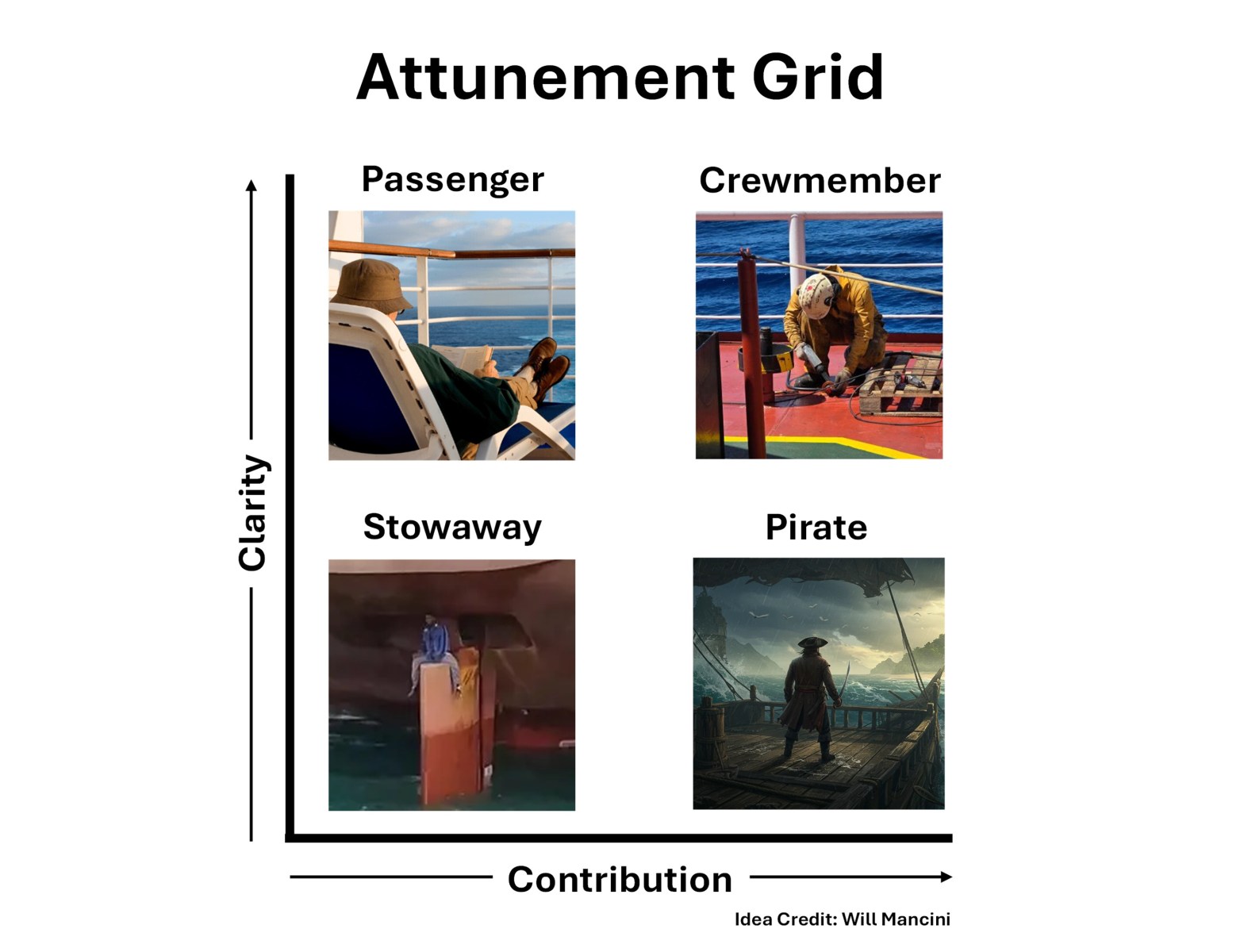
Will Mancini, author of Church Unique, talks about this concept in his Attunement Grid. He breaks up participants in an organization into four types of people on a ship. With effort, we can commission more as crew members and fewer as stowaways.
The Attunement Grid
Mancini uses a 2 x 2 grid to illustrate organizational members as those on a ship. They are graphed against two factors that determine how they interact onboard our vessel. The x-axis is contribution, and the y-axis is clarity.
Contribution is the energy that someone puts toward their work. At the high end, people are motivated, engaged, energized, and executing tasks. These people understand that things need to be done, and they’re the ones to do them. At the low end, these contributors are not participating. They do the minimum or less, simply drifting at sea and letting other people do the work.
Clarity is the level of understanding of the overall vision of the leader. Those on the top end of the spectrum have read the boss’s planning documents, have caught the vision, and are onboard with the organizational future. Those at the bottom of the spectrum do not understand or care where the organization is going; they’re just a part of it.
With these metrics, we can graph the souls on board the ship and understand how they interact within our group.
1. Stowaways: Low Contribution and Low Clarity. These people are neither actively participating nor understanding where the voyage is heading. While they’re on the ship, they don’t care where it goes or why it’s going to a certain port.
It’s important to find the stowaways hiding in the freight and help them understand the vision of the organization. Once they understand the vision, we can encourage them to participate in meaningful ways.
2. Pirates: High Contribution and Low Clarity. Good news! These people are contributing and making things happen. Bad news: they’re taking actions that aren’t actively helping the team. To continue the analogy, pirates are taking over our time, energy, and motivation to carry out the team’s purpose.
Yet, pirates are a great opportunity. They want to do things, so if we can align their actions with our vision, they can be a force multiplier. If we can’t, they’ll continue to board our ship and distract us from our mission.
3. Passengers: Low Contribution and High Clarity. The passengers understand where we want to go. They’re on board with the vision and love having other people row them there. They often watch things happen from the fringes and take little action to help. They’re nice to have around, but don’t actively participate.
Passengers are another great opportunity. Since they’re already sold on the mission, it’s important to find an area where they want to contribute. Sometimes, talking to these people and understanding their passions goes a long way toward offering them jobs they’ll enjoy doing.
4. Crew: High Contribution and High Clarity. Here we have the ones who are doing the Lord’s work. The crew understands the vision and is ready to pitch in whenever needed, often without being asked. They see the bigger picture and take immediate action to get things done.
We must constantly thank and celebrate the work of the crew. They’re the rowers who keep moving our vessel forward and are the heartbeat of the organization. A little recognition goes a long way, and if we can keep enough of the crew fed, valued, and happy, the ship will continue to sail smoothly.
Roles Can Change
Obviously, we want to move everyone toward being crew members, but some won’t come on board. It’s important to differentiate between the ones with potential to move up and to the right and the ones who will remain where they’re at.
It’s also important to keep in mind that a crew member can shift to a passenger at any time. If they see a passenger enjoying their cruise while avoiding work with no consequences, they might move in that direction.
The captain must constantly be watching those onboard and working to get them on the crew or keeping them there. The best way to do this is to have such a powerful vision and mission that they’ll want to row along with the boat. John Kotter would argue in his change model that this requires continuous overcommunication of our messaging. Even when we think those on the ship have heard the message enough, we need to tell them again.
Sadly, some people will never catch the vision or want to contribute. They’ll be stuck in stowaway mode and struggle to leave that quadrant. When this happens, sometimes the best thing to do is drop them at the next port. There’s no need for freeriders who don’t contribute or agree with the direction of the organization.
Managing Those Onboard
Managing organizational dynamics is the role of the leader. We all need to know who is performing and who cares about the mission. Once we can identify who is a stowaway, pirate, passenger, or crew member, we can start treating them accordingly to get them to make a positive impact on the ship.
The captain can’t just sit on the bridge all day. We have to get out among the deck hands, learn what drives them, and actively coach them so we can steer the entire crew toward the same horizon.
Click here to sign up for The Maximum Standard’s weekly email where you’ll get a leadership vignette delivered for free every Tuesday morning!
We’re always looking for authors. We coach first time authors (and anyone) through the writing process if you need a little help. It’s worth taking the first step to get published.
This website is a personal blog and all writings, podcasts, opinions, and posts are the authors’ own and do not represent the views of the United States Army nor any other organization. Podcast music credit in this audio file is to: “Alex Productions – Legends” is under a Creative Commons license (CC BY 3.0). / @alexproductionsnocopyright
 The Maximum Standard