November 17, 2026
By Michael Posey
We often celebrate the spectacular careers of leaders applauding their coveted assignments, advanced degrees, battlefield victories, and prestigious awards. We should commend those achievements, but this route is not the only way to define a legacy.
Many professionals exert their greatest influence quietly, through disciplined preparation, steady character, and genuine investment in other people. Excellence is not always represented by the best position or loudest voice. Sometimes, a legacy of quiet excellence is the most impactful.
As a new faculty member at the Army War College, I wanted to prove my worth and nail my first lesson on Operation Desert Storm. I combed through every reading several times, thought through the best questions to ask, and constructed a master slide deck. I felt confident after developing carefully sequenced and annotated PowerPoint slides, complete with curated graphics. If I got tripped up on my Gulf War knowledge, my beautiful slides would rescue me.
In the evening before my first War College lesson, most of the faculty had trickled out of the building. Professor Mike Marra, from his office next door, thoughtfully poked his head in to check on me. Mike, as he always did, looked the part of a War College professor: polished, prepared, with his nametag perfectly parallel to the deck.
His friendly smile came with an offer. “I’m making some hard copies of National Security Directive (NSD) 54 [a key reading for the lesson]. I like the students to read President Bush’s military objectives in print and then ask some questions. Do you want me to make you some copies? You never know when the classroom tech might fail.”
“Sure,” I replied, gladly accepting the stack of papers and writing down a few of his questions on the top sheet.
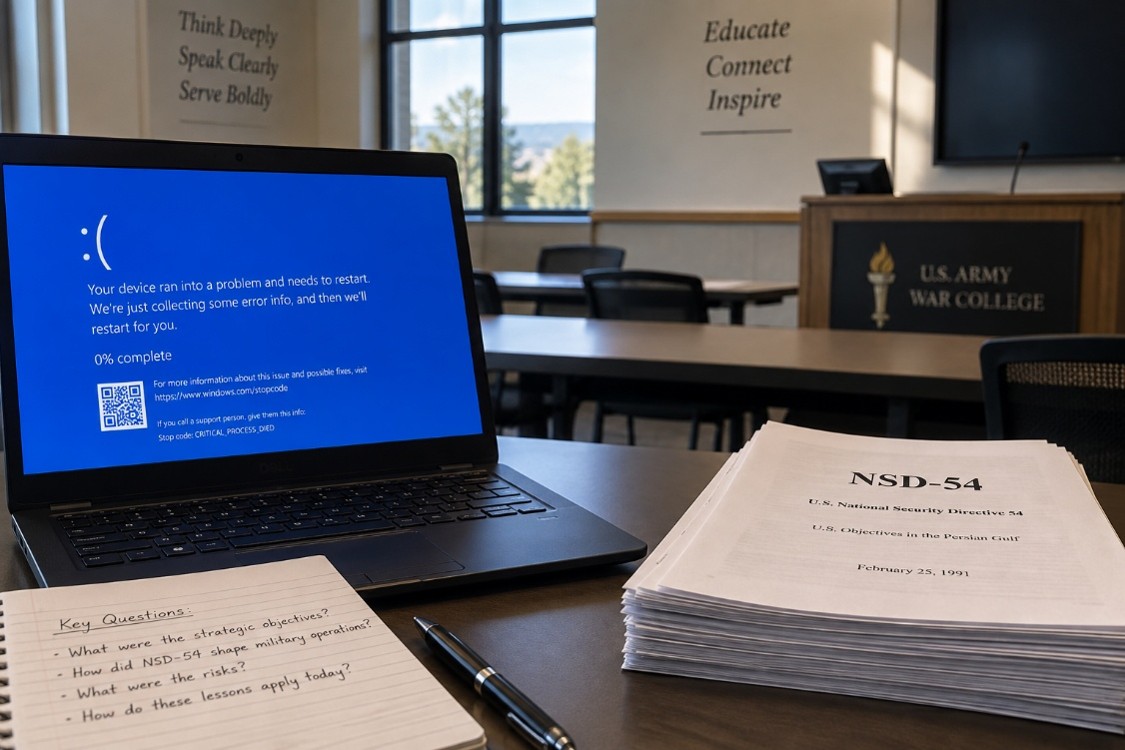
The next morning, I arrived at my classroom ridiculously early. I wanted to get the computers running so I could display my fancy slides. Then the classroom computer died. I could not connect my personal computer because I had forgotten the right cable. Finally, my government-issued computer displayed the infamous “Blue Screen of Death.”
My heart was pounding as I envisioned epic failure on my first day of teaching until I remembered Mike’s copies of NSD 54. Instead of floundering, I called tech support and ran the first hour of class with Mike’s paper copies and a few handwritten questions. Mike didn’t just help me survive one lesson. He showed me how professionals think.
For Mike Marra, arriving early, leaving late, and preparing relentlessly were never vanity projects. These habits showed his care for students and made everyone around him better. His career reflects three enduring military virtues often described as the three C’s of leadership: credibility, character, and connection.
Credibility – Preparation Before Performance
General Matthew Ridgway famously demonstrated credibility on the battlefield. His combat experience in World War II gave him a reservoir to draw from when he unexpectedly assumed command of the Eighth Army in Korea. He reenergized a force shaken by defeat by returning soldiers to the basics and restoring confidence. Just as decades of personal training shaped his leadership, he built credibility by training units to be combat-ready and strengthening unit cohesion. Ridgway proved that true credibility is not built in crisis, but through years of deliberate preparation.
General Omar Bradley later quipped that Ridgway’s turnaround was “the greatest feat of personal leadership in the history of the Army.” Ridgway did not manufacture credibility when he landed on the Korean Peninsula. Instead, he relied on preparation built long before he needed it.
After more than five years working beside Mike, I cannot remember ever seeing him unprepared. Each year I asked him to lead a session called “Life in the Seminar,” one of our first faculty-development events for new instructors. After more than two decades at the War College, he easily could have winged it. He never did. Mike still prepared because the session mattered to the new instructors sitting in the room.
His confidence came not from assuming his decades of experience would be enough, but from putting in the work before anyone was watching. Credibility does not emerge during a performance reserved for an important moment. It materializes from a lifetime of treating preparation as a habit.
Character – Giving Away the Credit
Not all examples of leadership come from four-star generals. Major Dick Winters’ assault on Brecourt Manor on D-Day, immortalized in Band of Brothers, remains a textbook example of small-unit leadership. Yet Winters was notable for how readily he gave credit to his soldiers.
In one engagement where he ran ahead of his troops and on his own for several minutes, the word “I” was noticeably absent from his after-action report, giving full credit to his men. His humility reinforced a basic truth: character often shows where a leader directs his attention and recognition.
I saw the same conduct from Mike. Shortly before he left the department, he took responsibility for updating our faculty handbook, a necessary and thankless job that was unlikely to earn anyone much recognition. When the handbook was finished, Mike made sure that other faculty on the project received letters of appreciation from the Commandant. He did the unglamorous work and then gave away the credit.
Beyond sharing recognition, Mike shared his lessons. When junior faculty faced difficult situations, we often sought him out like a wise guru. He remained calm, listened, and usually knew what we should solve at our level and what truly needed to go up the chain of command. Character was not something Mike advertised. It was evident in how he carried himself and shared his judgment. A leader’s character is ultimately revealed by how much credit they give away.
Connection – Multiplying Leaders
The AC-130 Gunship succeeds because an entire crew functions as one. Pilots, special mission aviators, and combat systems operators perform different tasks, but their precision depends on trust and shared understanding. Mike Marra may have left the gunship cockpit, but he never stopped operating that way. He traded an aircrew for a seminar and his fellow faculty.
John Boyd, the fighter pilot of OODA loop fame, framed a similar choice in his “To Be or To Do?” challenge. Boyd warned against allowing career advancement to become more important than doing consequential work. His formulation was intentionally provocative, but the central idea fits quiet professionals: influence matters more when it helps others accomplish something worthwhile.
Some of Mike’s most useful mentoring did not look like mentoring at all. He would quietly BCC new faculty on messages to his own seminar so we could see how an experienced professor scheduled advisor interviews, communicated expectations, or kept students informed. He shared examples of graded papers and feedback. Mike did not announce that he was mentoring us. Instead, he just let us look over his shoulder. In doing so, we could see his intentional approach to teaching.
He showed the same intentionality with students. At the end of each year, Mike created meaningful superlative awards for every member of his seminar, had them printed as certificates, and presented them one by one. He said something personal about each student and gave the seminar a few moments to say goodbye. It was a small gesture, but it shows how clearly Mike valued his relationships with every student. When mentors value connection, professional excellence can multiply, turning personal habits and hard-earned judgment into something others can carry forward.
The Legacy of Quiet Excellence
Great professionals are not remembered only for extraordinary resumes. Often, they are remembered because they changed people. Ridgway reminds us that credibility is earned before the crisis. Winters shows that character directs credit outward. Boyd reminds us to choose meaningful contribution over personal status. Mike demonstrated all three without needing his name to become a case study.
You will not find books about Mike Marra in our War College library. What you will find are students and faculty who remember how he made them better. Maybe he was the professor who encouraged someone to improve a paper, the colleague who helped a new instructor navigate a difficult situation, or the mentor who quietly showed someone how the job was done.
In my sixth year of teaching, I still print a page of notes before every lesson, even when the class meets on Microsoft Teams. Mike taught me, among dozens of things, to have something tangible beside me: questions, reminders, or a backup plan for when technology inevitably misbehaves.
Someday, perhaps, a student or newer faculty member will pick up one of Mike’s habits from me without ever knowing where it started. That is the legacy of quiet excellence.
Mike Posey is an active-duty Naval Flight Officer in the E-2C Hawkeye and the F/A-18F Super Hornet. He is a father of two phenomenal children and the husband of a fantastic woman. He holds business degrees from Carnegie Mellon University and the University of Florida and is a doctoral candidate (ABD) in education from Penn State University. He currently teaches at the U.S. Army War College.
Click here to sign up for The Maximum Standard’s weekly email where you’ll get a leadership vignette delivered for free every Tuesday morning!
We’re always looking for authors. We coach first time authors (and anyone) through the writing process if you need a little help. It’s worth taking the first step to get published.
The views expressed here are the author’s own and do not necessarily reflect those of the Department of the Army, Department of War, or the U.S. Government.

